
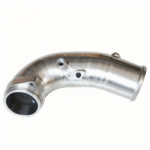

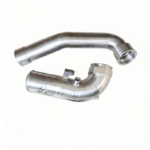
Titan-Ladeluftkühlerrohr Präzisionsrohrbiegen 2,5 Zoll Außendurchmesser Titan
Kundenspezifisches Titan-Ladeluftkühlerrohr, hergestellt mit präziser Rohrbiegetechnologie und leichtem Titanmaterial für turbogeladene Systeme.
Request a Quote
Enter the quantity you need and add to your quote list for pricing inquiries.
Product Details
Warum ein Titan-Ladeluftkühlerrohr wählen?
Bevor wir den Biegeprozess besprechen, hilft es zu verstehen, warum Kunden überhaupt ein Titan-Ladeluftkühlerrohr suchen. Titan bietet drei entscheidende Vorteile gegenüber herkömmlichen Materialien.
Der erste Vorteil ist die Gewichtsreduzierung. Titan hat etwa die halbe Dichte von Stahl bei vergleichbarer oder besserer Zugfestigkeit. Ein Titanrohr wiegt etwa 40 bis 50 Prozent weniger als ein Stahlrohr mit denselben Abmessungen. Für Rennwagen, Driftfahrzeuge und Zeitangriffsfahrzeuge trägt jedes eingesparte Pfund zu schnelleren Rundenzeiten, besserer Beschleunigung und verbessertem Handling bei.
Der zweite Vorteil ist die Hitzebeständigkeit. Titan leitet Wärme effektiver ab als Edelstahl und widersteht Hitzestau besser als Aluminium. Diese Art von Rohrleitung hält die Ladeluft vom Turboladerauslass bis zum Ladeluftkühlereinlass und vom Ladeluftkühlerauslass bis zur Drosselklappe kühler. Niedrigere Ansauglufttemperatur bedeutet mehr Leistung und ein geringeres Risiko von Motorklopfen.
Der dritte Vorteil ist die Haltbarkeit. Titan rostet nie und widersteht Rissen durch Vibrationen weitaus besser als Aluminium. Ein Titanrohr, das in einem Alltags- oder Rennfahrzeug verbaut wird, hält länger als das Fahrzeug selbst. Angesichts dieser Vorteile wächst die Nachfrage nach Titan-Ladeluftkühlerrohrleitungen im Automobil-Ersatzteilmarkt weiter.

Warum das Biegen von Titan-Ladeluftkühlerrohren schwierig ist?
Titan ist nicht wie Stahl oder Aluminium. Es verhält sich unter Belastung anders. Mehrere Faktoren machen das Biegen von Titan-Ladeluftkühlerrohren zu einem spezialisierten Service, der nur von erfahrenen Werkstätten versucht werden sollte.
Titan hat eine hohe Rückfederung. Beim Biegen versucht Titan, aggressiver in seine ursprüngliche Form zurückzukehren als Stahl. Ein Präzisionsbiegedienst muss das Rohr deutlich stärker überbiegen als bei Stahl, typischerweise 2 bis 4 Grad, abhängig von der Güte und Wandstärke.
Titan kaltverfestigt sich schnell. Jeder Grad Biegung macht das Material härter und widerstandsfähiger gegen weitere Verformung. Dies erhöht das Risiko von Rissen, wenn die Biegung nicht korrekt in einer gleichmäßigen Bewegung ausgeführt wird. Die Biegegeschwindigkeit muss sorgfältig kontrolliert werden.
Titan erfordert spezielle Schmierung und Werkzeuge. Standard-Biegeschmierstoffe bieten möglicherweise keine ausreichende Filmfestigkeit. Werkzeuge müssen auf Hochglanz poliert sein, um Festfressen zu verhindern, einen Zustand, bei dem Titanpartikel an der Matrizenoberfläche haften bleiben und die Rohroberfläche ruinieren.
Titan ist hitzeempfindlich. Im Gegensatz zu Stahl, der warm gebogen werden kann, wird das Biegen von Titan-Ladeluftkühlerrohren typischerweise kalt durchgeführt, um die Materialeigenschaften zu erhalten. Übermäßige Hitze kann das Mikrogefüge von Titan verändern und die Festigkeit verringern. Aus diesen Gründen sollten nur Werkstätten mit nachgewiesener Erfahrung im Titanbiegen Aufträge für Titan-Ladeluftkühlerrohre annehmen.
Beste Biegeverfahren für Titan-Ladeluftkühlerrohre:
Nicht alle Biegeverfahren sind für Titan geeignet. Das Material erfordert das höchste Maß an Präzision und Sorgfalt. Dornbiegen ist die einzig akzeptable Methode für ein Titan-Ladeluftkühlerrohr, das im Motorraum sichtbar sein wird. Ein flexibler Dorn, der in das Rohr eingeführt wird, verhindert Ovalität und Kollaps. Ohne Dorn zeigen Biegungen von Titan-Ladeluftkühlerrohren sichtbare Faltenbildung am Innenradius. Dies sieht nicht nur unprofessionell aus, sondern erzeugt auch Turbulenzen im Rohr, was den Luftstrom und die Effizienz des Ladeluftkühlers verringert.
CNC-Dornbiegen ist für die Herstellung von Titan-Ladeluftkühlerrohren nicht verhandelbar. Manuelles Biegen kann die für mehrere Einheiten erforderliche Konsistenz nicht erreichen. CNC-Maschinen steuern Biegewinkel, Drehung und Vorschubgeschwindigkeit mit hoher Präzision. Bei Titan muss die Biegegeschwindigkeit sorgfältig kalibriert werden, um Kaltverfestigungsprobleme zu vermeiden. Rotationszugbiegen mit einem Dorn ist der Standardaufbau. Das Rohr wird eingespannt und um eine feste Radiusmatrize gezogen, während der Dorn die Innenwand stützt. Für Titan-Ladeluftkühlerrohranwendungen muss der Dorn aus gehärtetem Werkzeugstahl mit einer polierten Oberfläche bestehen, um Festfressen zu verhindern.
Kritische Konstruktionsspezifikationen für Titan-Ladeluftkühlerrohre:
Um ein überlegenes Titan-Ladeluftkühlerrohr zu liefern, muss Ihr Team mehrere Parameter präzise kontrollieren. Der Rohrdurchmesser liegt für die meisten Ladeluftkühleranwendungen typischerweise zwischen 2 und 4 Zoll Außendurchmesser. Übliche Größen umfassen 2,5 Zoll, 3 Zoll und 3,5 Zoll. Die Wandstärke für ein Titan-Ladeluftkühlerrohr beträgt normalerweise 0,035 bis 0,065 Zoll. Titan ist stark genug, dass dünne Wände ausreichende Berstfestigkeit bieten und gleichzeitig maximales Gewicht sparen.
Der Biegeradius bestimmt, wie eng das Titan-Ladeluftkühlerrohr um Motorkomponenten herumgeführt werden kann. Der minimale Biegeradius in der Mittellinie für Titan beträgt im Allgemeinen das 2,5- bis 3-fache des Rohrdurchmessers. Für ein Titan-Ladeluftkühlerrohr mit 3 Zoll Außendurchmesser entspricht dies einem Radius von 7,5 bis 9 Zoll. Engere Radien sind mit speziellen Dornen und langsameren Biegegeschwindigkeiten möglich, aber das Risiko von Faltenbildung steigt.
Die Wanddickenabnahme-Toleranz ist für die Leistung von Titan-Ladeluftkühlerrohren entscheidend. Während des Biegens dehnt sich die Außenwand und wird dünner. Bei Titan sollte die Wanddickenabnahme 10 Prozent der ursprünglichen Dicke nicht überschreiten. Das Überschreiten dieser Grenze erzeugt eine Schwachstelle, die unter Ladedruck eines Hochleistungsmotors bersten könnte. Die Rückfederungskompensation ist bei Titan höher als bei Stahl. Ein typisches Titan-Ladeluftkühlerrohr kann eine Überbiegung von 2 bis 4 Grad erfordern.
Titan-Werkstoffgüten für Ladeluftkühlerrohre:
Verschiedene Titangüten bieten unterschiedliche Eigenschaften für Ladeluftkühlerrohranwendungen. Titan der Güte 2 ist technisch reines Titan. Es bietet ausgezeichnete Korrosionsbeständigkeit und gute Verformbarkeit. Güte 2 ist leichter zu biegen als höhere Güten, hat aber eine geringere Festigkeit. Für ein Titan-Ladeluftkühlerrohr in einem mild getunten Straßenfahrzeug ist Güte 2 eine gute Wahl.
Titanlegierung Grad 5, auch bekannt als Ti 6Al 4V, ist die häufigste Legierung für Hochleistungsanwendungen. Sie enthält 6 Prozent Aluminium und 4 Prozent Vanadium. Grad 5 bietet eine deutlich höhere Festigkeit als Grad 2, ist aber schwieriger zu biegen. Ein Titan-Ladeluftkühlerrohr aus Grad 5 kann sehr hohe Ladedrücke und extreme Temperaturen bewältigen.
Titanlegierung Grad 9, oder Ti 3Al 2.5V, bietet ein Gleichgewicht zwischen Umformbarkeit und Festigkeit. Es ist einfacher zu biegen als Grad 5, aber stärker als Grad 2. Grad 9 ist eine ausgezeichnete Wahl für ein Titan-Ladeluftkühlerrohr, das komplexe Biegungen erfordert. Ihr Biegedienst sollte die Legierung mit dem Kunden bestätigen, bevor die Biegemaschine programmiert wird.


Qualitätskontrolle für das Biegen von Titan-Ladeluftkühlerrohren:
Jede Charge von Titan-Ladeluftkühlerrohren sollte vor dem Versand mehrere Qualitätsprüfungen bestehen. Die Ovalitätsmessung stellt sicher, dass der Querschnitt des gebogenen Rohrs zu mindestens 95 Prozent kreisförmig bleibt. Die akzeptable Ovalität für ein Titan-Ladeluftkühlerrohr liegt unter 5 Prozent. Eine höhere Ovalität stört den Luftstrom und verursacht Druckabfälle.
Die Wanddickenprüfung stellt sicher, dass die Ausdünnung unter 10 Prozent bleibt. Für Titan werden Ultraschall-Wanddickenmessgeräte empfohlen. Die Oberflächenzustandsprüfung sucht nach Kaltaufschweißungen, Kratzern oder Werkzeugspuren. Ein Titan-Ladeluftkühlerrohr wird oft roh belassen oder klarlackiert, um das Material zu präsentieren, sodass jeder Oberflächenfehler sofort sichtbar ist.
Die Maßprüfung stellt sicher, dass jeder Biegewinkel innerhalb von plus/minus 0,5 Grad der Spezifikation liegt. Diese Prüfung wird mit einem Koordinatenmessgerät oder einer kundenspezifischen Lehrenvorrichtung durchgeführt. Erste Artikelprüfberichte werden den Kunden zur Genehmigung vorgelegt, bevor die Serienproduktion beginnt.
Fazit:
Ein Titan-Ladeluftkühlerrohr ist eine Premiumkomponente, die eine erstklassige Fertigungsqualität erfordert. Jede Biegung muss präzise sein. Jede Oberfläche muss glatt sein. Jede Messung muss innerhalb der Toleranz liegen. Durch die Lieferung präziser, dorngebogener Titanrohre mit engen Toleranzen und makellosen Oberflächen wird Ihr Rohrbiegedienst zu einem unverzichtbaren Partner für Automobilmarken, die bei der Leistung keine Kompromisse eingehen.