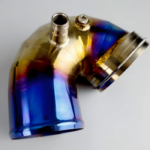
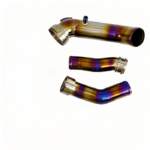
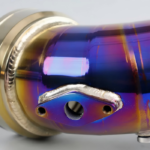
Superior Titanium Intake Pipe Welding Service 5 Layer Heat Shield Design for Race Ready Turbocharged Engines
Request a Quote
Enter the quantity you need and add to your quote list for pricing inquiries.
Product Details
We provide professional titanium intake pipe welding service with back purging and precision TIG welding to deliver smooth bore pipes that increase airflow and engine response.
Why Standard Intake Pipes Fall Short?
Most factory intake pipes are made from plastic or corrugated rubber. These materials absorb heat from the engine bay, warming the incoming air before it reaches the engine. Warmer air is less dense, which reduces power output. Plastic pipes can also crack over time from heat cycling and vibration.
Aftermarket aluminum intake pipes solve some of these problems but introduce others. Aluminum conducts heat readily, so an aluminum intake pipe sitting above a hot engine can actually heat the intake air. Aluminum also weighs more than titanium and offers no advantage in corrosion resistance. A titanium intake pipe solves all these problems while adding unique benefits.
The Titanium Advantage for Intake Pipes:
First, thermal properties. Titanium has lower thermal conductivity than aluminum. A titanium pipe heats up more slowly and stays cooler than aluminum in the same engine bay environment. Cooler intake air means denser air charge and more power.
Second, weight. Titanium has an exceptional strength-to-weight ratio. A titanium pipe typically weighs 40 to 50 percent less than an aluminum pipe of equal strength. For performance vehicles, every pound saved matters.
Third, durability. Titanium resists cracking from vibration and heat cycling. A properly fabricated titanium pipe will outlast the vehicle. It never corrodes, even in harsh engine bay conditions.
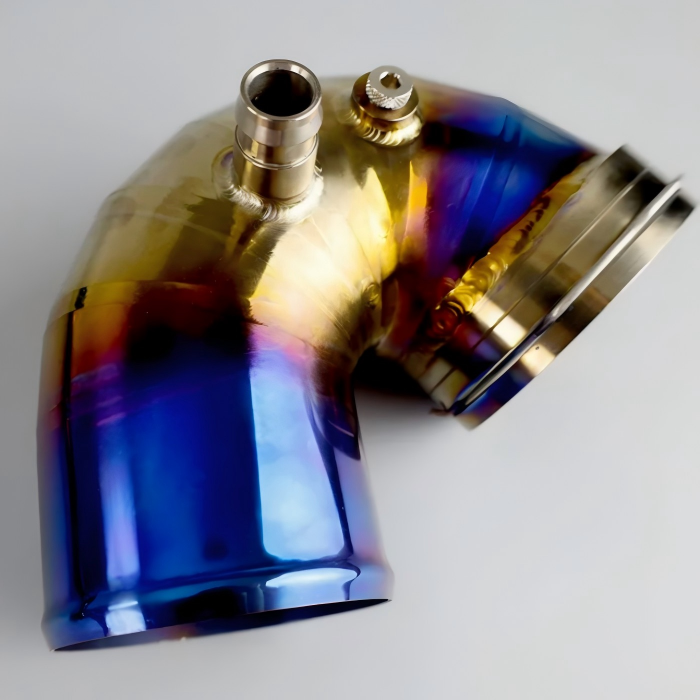
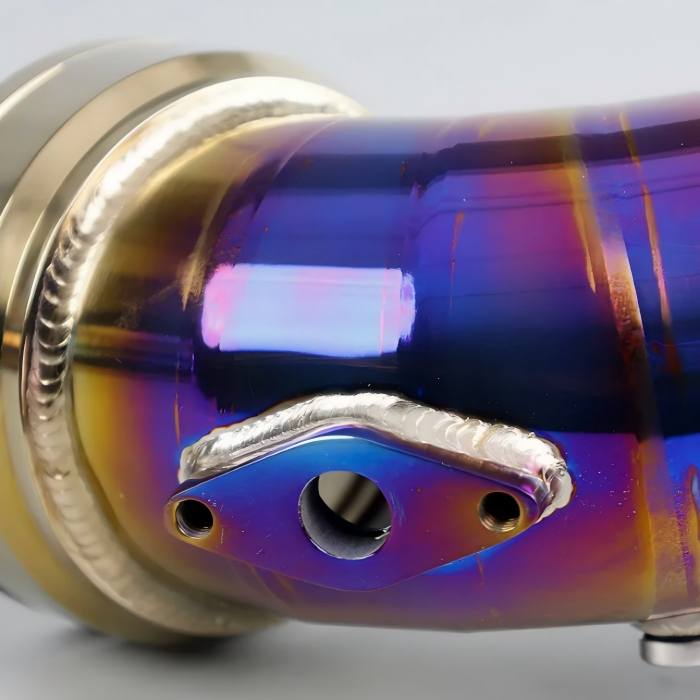
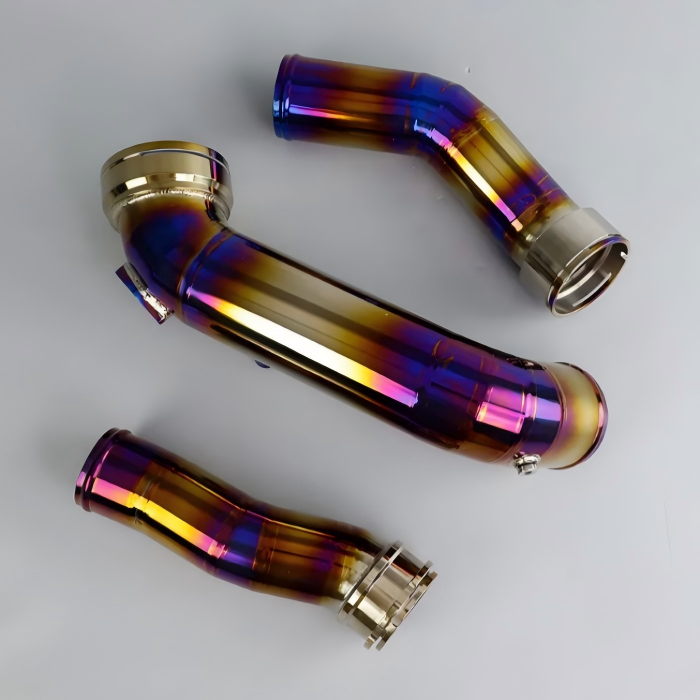
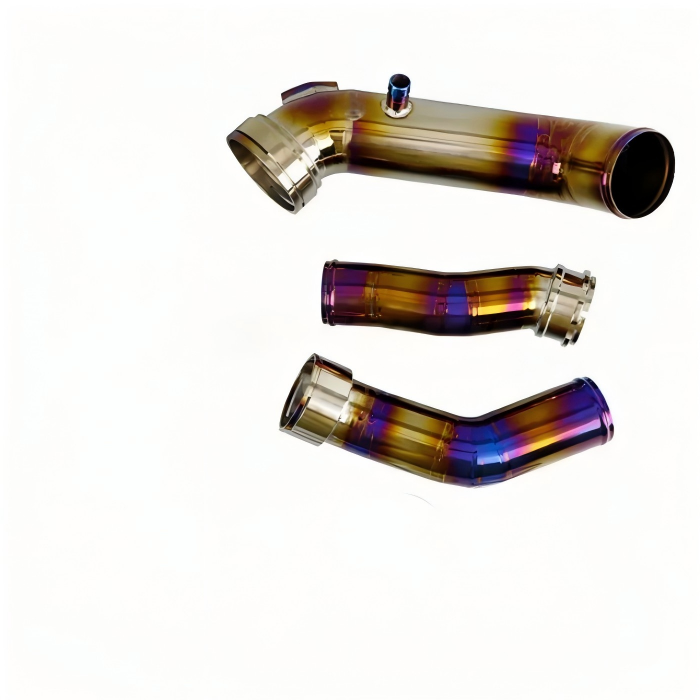
Fourth, aesthetics. Titanium develops a distinctive blue and gold coloration when heated during welding. A titanium intake pipe looks like a high-performance component because it is one. Many enthusiasts choose this material as much for its visual appeal as its performance benefits.
Design Features of a Quality Titanium Intake Pipe:
A well-designed titanium intake pipe includes several important features. The inside diameter must match the engine’s airflow requirements. Too small restricts flow. Too large reduces air velocity. Typical diameters range from 2.5 inches to 4 inches depending on engine size and power level.
The pipe should have smooth internal surfaces. Any weld penetration on the inside of a titanium intake pipe creates turbulence that disrupts airflow. Quality fabricators back-purge their welds to produce smooth internal profiles.
Mandrel bends maintain constant diameter through curves. A titanium intake pipe with mandrel bends flows significantly better than one with crimped or crushed bends. The bend radius should be as generous as packaging allows.
Mounting tabs and sensor bungs must be properly positioned. A titanium intake pipe often includes a bung for the intake air temperature sensor and tabs for securing the pipe to the engine or chassis.
Challenges of Welding a Titanium Intake Pipe:
Titanium presents serious fabrication challenges. Titanium is highly reactive when exposed to oxygen, nitrogen, and hydrogen at elevated temperatures. During welding of a titanium intake pipe, every weld zone must be completely shielded from atmospheric contamination. If shielding fails, the titanium absorbs these elements, resulting in embrittlement and cracking.
Intake pipes involve thin-walled tubing, typically 0.8mm to 1.5mm thick. Thin titanium requires precise heat control to avoid burn-through. Additionally, a titanium intake pipe has multiple joints including straight sections to bends, mounting tabs to the pipe, and sensor bungs to the pipe wall.
The inside of the pipe must be purged with inert gas during welding. Without back-purging, the root side of each weld oxidizes, creating a rough internal surface that disrupts airflow. For a titanium intake pipe, smooth internal welds are just as important as external appearance.
Critical Steps for Welding a Titanium Intake Pipe:
Successful fabrication of a titanium intake pipe begins long before the arc is struck:
Material selection: Grade 2 commercially pure titanium or Grade 5 (6Al-4V) titanium is commonly used for a titanium intake pipe. Grade 2 offers excellent formability and weldability. Grade 5 provides higher strength for turbocharged applications.
Tube preparation: Titanium tubes must be cut precisely, deburred, and cleaned inside and out. Use acetone or isopropyl alcohol followed by a dedicated stainless steel brush used only on titanium. Any contamination leads to weld defects.
Fit-up: For a titanium intake pipe, joint gaps should not exceed 0.3mm. Use fixtures to maintain alignment. Poor fit-up leads to burn-through or incomplete fusion.
Back-purging: The inside of the pipe must be purged with pure argon at 99.999 percent purity. Without back-purging, the root side of each weld oxidizes, creating turbulence-causing roughness.
Torch setup: Gas tungsten arc welding (GTAW/TIG) is the only process recommended for a titanium intake pipe. Use a 2 percent ceriated or lanthanated tungsten electrode. A gas lens improves coverage. Set post-flow to at least 15 seconds.
Heat control: Thin titanium requires precise heat input. Too little heat produces incomplete penetration. Too much heat causes burn-through. Pulse techniques help manage heat on thin wall tubing.
Common Defects in Titanium Intake Pipe Welding:
Even experienced welders may encounter defects when fabricating a titanium intake pipe:
Oxidation and discoloration: Silver or light straw welds indicate proper shielding. Blue, purple, or grey means contamination. An oxidized titanium intake pipe is cosmetically unacceptable and structurally compromised.
Burn-through: Excessive heat creates holes in thin tubing. Reduce amperage or increase travel speed. Burn-through typically means scrapping the part.
Incomplete penetration: The weld does not fully bond through the tube wall. On a titanium intake pipe, incomplete penetration creates a crack-like discontinuity. Adjust parameters and refit the joint.
Internal oxidation: Even if the external weld looks good, inadequate back-purging causes internal discoloration. A titanium intake pipe with internal oxidation has reduced airflow and potential flaking contamination.
Visual and Internal Inspection Standards:
A properly welded titanium intake pipe displays bright silver or pale straw colored welds on the exterior. The weld bead should be uniform with smooth ripples. Internally, the welds should appear silver with no discoloration.
The inside of the pipe must be smooth. Any weld protrusion or oxidation requires rejection. Many fabricators use borescopes to inspect the internal surface of every titanium intake pipe.
Applications and Market Demand:
The demand for a premium titanium intake pipe spans several markets. Turbocharged and supercharged engines benefit most from reduced intake restriction and lower intake air temperatures. JDM performance cars including Nissan GT-R, Mitsubishi Evo, Subaru WRX, and Toyota Supra are popular platforms.
European exotics such as Porsche, Lamborghini, and Ferrari owners seek titanium intake pipes for both performance and visual appeal. Custom engine builders and race teams specify titanium for its weight savings and heat rejection properties.
Motorcycles also benefit. A titanium intake pipe for a sportbike reduces weight and improves throttle response.
Conclusion:
A titanium intake pipe represents the ultimate expression of intake system engineering. When welded correctly by experienced professionals, it delivers cooler intake air, reduced weight, permanent corrosion resistance, and distinctive visual appeal. For enthusiasts who demand the best, titanium is the clear choice.