Metal Stamping Metal Stamping & Reliable Custom Sheet Metal Solutions
Angebot anfordern
Geben Sie die benötigte Menge ein und fügen Sie sie Ihrer Angebotsliste für Preisanfragen hinzu.
Description
High Precision Metal Stamping Solutions From Flow Wing Metal
What is Metal Stamping?
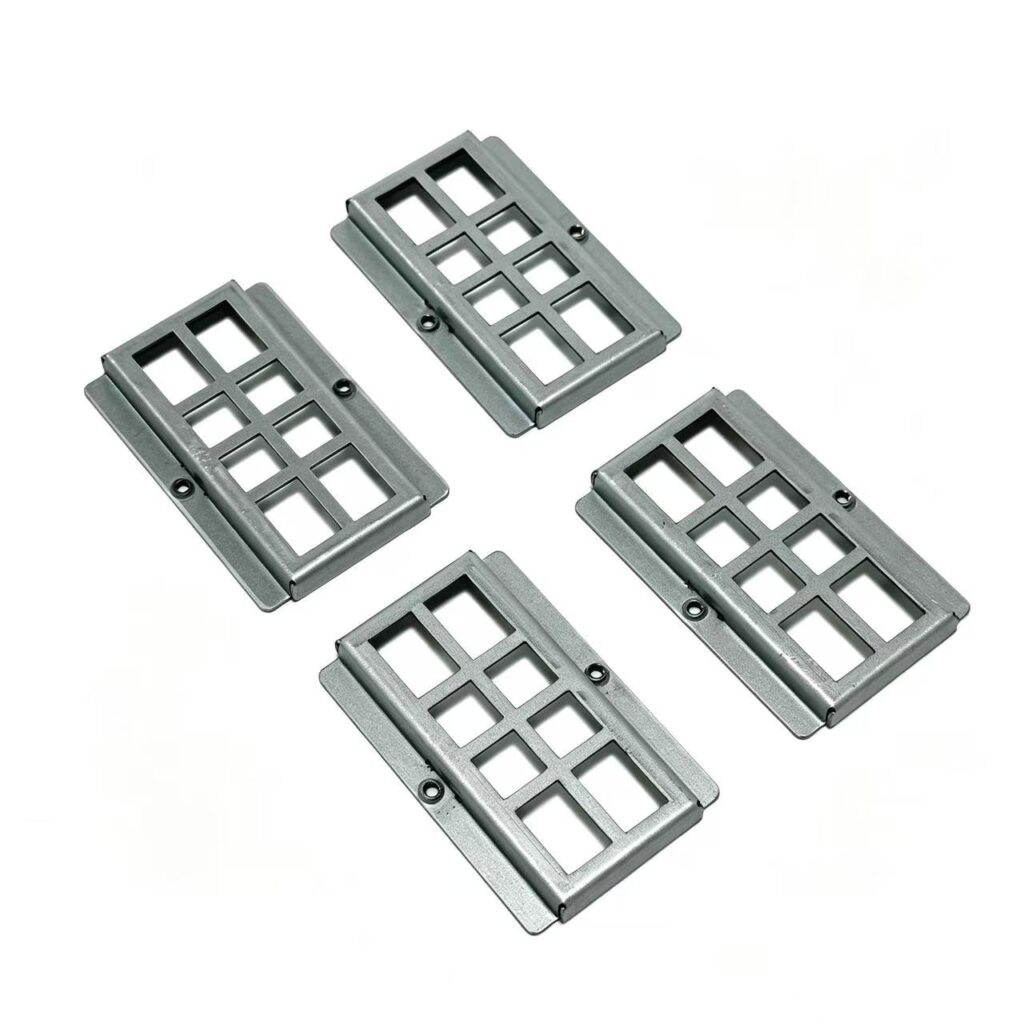
Metal stamping is a cold forming manufacturing process that converts flat metal sheets or coils into specific shapes using a press machine and dedicated tooling (dies). Unlike machining (which removes material), stamping reshapes metal through pressure induced deformation or shearing.
The process involves placing sheet metal (blank) into a stamping press where a tool and die surface form the metal into a desired geometry. Stamping is ideal for high volume production because once the dies are fabricated, parts can be produced rapidly with exceptional consistency and low per unit cost.
Common Metal Stamping Operations
| Operation | Description | Typical Applications |
| Blanking | Cutting a desired shape (blank) from a larger sheet of material. | Discs, squares, washers, custom-shaped parts. |
| Piercing | Punching holes (round, slotted, or shaped) through the metal. | Mounting holes, ventilation grilles, alignment features. |
| Bending | Forming angles or curves along a straight axis in the metal. | Brackets, clips, chassis components, enclosures. |
| Forming / Drawing | Stretching flat sheet into a three-dimensional concave shape (e.g., a cup or pan). | Enclosures, housings, automotive body panels, sinks. |
| Embossing | Creating raised or recessed designs (letters, logos, ribs) without piercing the material. | Nameplates, structural stiffeners, decorative panels. |
| Coining | High-pressure compression to create precise, sharp features or flattened surfaces on both sides. | Electrical contacts, precision spacers, coins, medals. |
| Lancing | Partially cutting and bending a section out of the parent material, leaving it attached. | Louvers, vents, spring tabs, retaining tabs. |
At Flow Wing Metal, we combine progressive die engineering, high tonnage press capability, and strict quality control to deliver stamped components that meet aerospace, automotive, and industrial standards.
Stamping Processes: Press Types
The method of stamping depends on production volume and part complexity.
- Progressive Die Stamping
A single press stroke advances the metal strip through a series of stations, each performing a different operation (pierce → form → coin → blank). The completed part is cut free at the final station.
Best for: High volume parts (50,000+ units/year), complex geometries, tight tolerances.
Flow Wing Advantage: Up to 60 strokes per minute with multistation tooling, reducing handling labor by over 80%.
- Transfer Stamping
The part is mechanically transferred between separate die stations within the same press. This allows for larger, heavier parts that cannot remain attached to a carrier strip.
Best for: Large automotive body panels, enclosure bases, components requiring deep drawing.
- FourSlide (Multi Slide) Stamping
Horizontal press motion from four directions allows complex bending and forming from wire or narrow strip stock in a single cycle.
Best for: Small, intricate parts such as springs, clips, and electronic connectors.
- Fine Blanking
A specialized process using tripleaction pressure (counterpressure, Vring, and blanking punch) to produce parts with fully sheared, smooth edges without secondary machining.
Best for: Gears, cams, transmission components, parts requiring flatness of 0.001″ per inch.
Materials for Metal Stamping
Flow Wing Metal stamps a wide range of ductile metals that can withstand cold forming stresses without cracking.
| Material Category | Common Grades | Stamping Characteristics |
| Carbon Steel | AISI 1008, 1010, 1018, 1020, Q235, Q275, Q345 | Excellent ductility; easy to blank and bend; low cost; requires corrosion protection if uncoated. |
| Rostfreier Stahl | 210, 304, 304L, 316, 316L, 410, 430 | Work-hardens rapidly so requires higher tonnage; excellent corrosion resistance post-stamping; galling can occur without proper lubrication. |
| Aluminium | 1006, 1010, 2024, 3003, 5052, 6061, etc | Lightweight and soft; lower press tonnage needed; prone to scratching; requires polished dies. |
| Copper & Brass | C110 (electrolytic copper), C260 (cartridge brass), C360 | Very soft and conductive; excellent for electrical contacts; easy forming but high springback. |
| Galvanized Steel | ASTM A653 (G30, G60, G90) | Zinc-coated for corrosion resistance; stamping must avoid flaking or damaging the coating. |
| High-Strength Low-Alloy (HSLA) | Various | Stronger than carbon steel but still formable; used for structural and automotive safety components. |
| Pre-plated Metals | Tin-plated steel, nickel-plated copper | Stamped directly without post-plating; requires careful tooling to avoid scratching the plating. |
Surface Finishing for Stamped Parts
Stamping often leaves burrs, lubricant residues, or light tooling marks. Flow Wing Metal offers a full range of poststamping surface treatments.
| Finish Process | Description | Typical Applications |
| As-Stamped (Degreased only) | Parts are cleaned of forming lubricants using alkaline or ultrasonic wash. Burrs may remain if not specified. | Internal components, temporary parts, prototypes |
| Deburring / Tumbling | Mass finishing with ceramic or plastic media removes sharp edges and light burrs. | Brackets, clips, any part requiring safe handling |
| Vibratory Finishing | Gentle polishing in a vibratory bowl with abrasive media; produces a uniform matte or slightly polished surface. | Decorative hardware, cosmetic covers |
| Electropolishing | Reverse-plating process that removes a microscopic layer of metal, leaving a smooth, bright, and passivated surface (ideal for stainless steel). | Medical devices, pharmaceutical equipment, food contact parts |
| Passivation | Chemical treatment (citric or nitric acid) removes free iron and restores the chromium oxide layer on stainless steel. | Marine, chemical, and outdoor stainless components |
| Powder Coating | Electrostatic application of colored polymer powder, then oven-cured to a durable, scratch-resistant finish. | Outdoor brackets, automotive underbody parts, enclosures |
| Zinc Plating (Electrogalvanizing) | Electrolytic application of a thin zinc layer for corrosion resistance (clear, yellow, or black chromate conversion available). | Fasteners, brackets, hardware exposed to indoor or mild outdoor conditions |
| Anodizing (Aluminum only) | Electrochemical thickening of the natural oxide layer; can be clear or dyed (black, red, gold, etc.). | Consumer electronics housings, architectural trim, nameplates |
| Painting / Silk Screening | Liquid paint application or ink printing for logos, symbols, or instructional text. | Control panels, rating plates, decorative parts |