Superior Valve Block Hydraulic Precision CNC With 100 Pressure Testing For Flawless Leak Proof Operation
Demande de devis
Saisissez la quantité dont vous avez besoin et ajoutez-la à votre liste de devis pour obtenir des informations sur les prix.
Détails du produit
Custom Valve Block Hydraulic CNC machining from aluminum or steel any port size any cavity type upload your schematic for a free instant quote.
What Is a Valve Block Hydraulic?
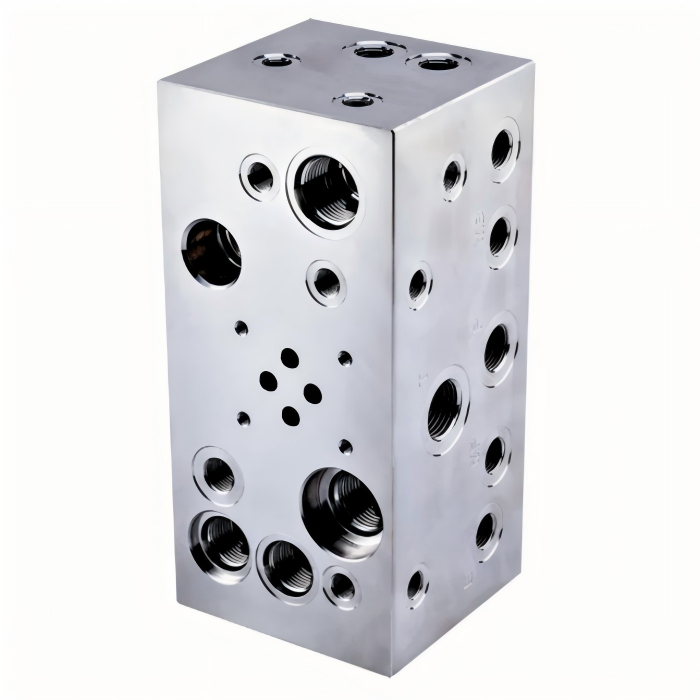
A hydraulic valve block is a machined metal component that contains internal passages, ports, and cavities designed to house valves, cartridges, or spools. It functions as a manifold that directs hydraulic fluid from the pump to actuators like cylinders or motors, then back to the tank. A typical unit includes precisely drilled channels, threaded ports for hose or tube connections, mounting surfaces for cartridge valves, and often pressure gauge ports or test points.
These blocks are commonly manufactured from aluminum, steel, or ductile iron. The complexity of such a component can range from simple two-port blocks to highly complex units with dozens of integrated functions. When your application requires specific port locations, unique flow paths, or custom valve integration, a custom CNC-machined hydraulic block is the only practical solution.


Why Standard Valve Block Hydraulic Options Often Fall Short?
Mass-produced valve block hydraulic units are designed for general applications. They come in fixed port configurations, standard thread types, and limited flow capacities. While they work for basic systems, they frequently struggle in specialized or space-constrained installations. For instance, a standard valve block hydraulic might have ports located in positions that conflict with existing machine structures, forcing awkward hose routing or additional adapters.
Another limitation is functional integration. Off-the-shelf valve blocks typically offer limited combinations of cartridge valves, check valves, flow controls, or relief valves. If your circuit requires a unique sequence of operations or a specific arrangement of pilot signals, a generic valve block hydraulic cannot deliver. Furthermore, standard blocks are often designed for nominal flow rates and pressures. High-performance or heavy-duty applications demand custom port sizes, larger internal passages, and heavier wall sections.
Standard materials are also limiting. A cast aluminum valve block hydraulic might be adequate for low-pressure applications but will fail under high pressure or in abrasive environments. Steel or stainless steel may be required for durability, corrosion resistance, or high-pressure operation. This is where CNC customization transforms the valve block hydraulic from a generic manifold into a precision-engineered component tailored exactly to your system.
The CNC Advantae: Redefining What a Valve Block Hydraulic Can Be
CNC machining allows us to produce a valve block hydraulic with tolerances as tight as ±0.01mm for critical bore diameters and port locations. Unlike casting or forging, which require expensive tooling and long lead times, CNC fabrication is flexible, accurate, and repeatable. Every valve block hydraulic we produce starts from a solid billet of metal—aluminum, steel, or stainless steel—and is precision milled, drilled, and tapped to your exact CAD model.
Key Customization Parameters for Your Valve Block Hydraulic:
When you choose to partner with us, every aspect of your valve block hydraulic can be tailored to your hydraulic circuit and operating conditions.
1. Material Selection
- 6061 Aluminum: Lightweight, corrosion-resistant, ideal for mobile equipment and low to medium pressure applications up to 3000 PSI.
- 7075 Aluminum: Higher strength aluminum for high-pressure mobile applications requiring weight savings.
- 1045 Carbon Steel: Excellent strength and wear resistance for industrial and heavy-duty applications.
- 4140 Alloy Steel: High tensile strength for extreme pressure applications up to 6000 PSI or more.
- 304/316 Stainless Steel: For corrosive environments including marine, chemical, or food processing applications.
- Ductile Iron: Good vibration damping and cost-effectiveness for large industrial valve blocks.
2. Port Configuration and Thread Types
We customize your valve block hydraulic with any port arrangement. Port sizes range from 1/8 inch to 2 inch NPT, BSPP, BSPT, SAE straight thread (ORB), JIC, or metric threads. We can also machine custom port locations and orientations to match your existing hoses and tubes exactly.
3. Internal Flow Passages
The internal drilling pattern of your valve block hydraulic determines how fluid flows between components. We design and machine complex intersecting passages, cross-drilled channels, and directional flow paths based on your hydraulic schematic. Any flow pattern is possible.
4. Cartridge Valve Cavities
We machine precise cavities for standard cartridge valves including Sun, Eaton, HydraForce, Parker, or any other brand. Cavity types include 08, 10, 12, 16, 20, 24 sizes for check valves, relief valves, flow controls, logic elements, and proportional valves. Your valve block hydraulic can integrate multiple valve functions in a single compact block.
5. Mounting Surface and Interface
Whether you need a standard CETOP (ISO 4401) interface, a custom mounting pattern, or direct cylinder mounting, we machine your valve block hydraulic to bolt directly to your existing components. We also add o-ring grooves, dowel pin holes, and bolt patterns as required.
6. Pressure Rating and Safety Features
Every custom valve block hydraulic is designed for your specific operating pressure. We can add pressure test ports, pilot ports, drain ports, or accumulator connection points. For high-pressure applications, we ensure adequate wall thickness and safe design margins.
7. Surface Treatment
Enhance your valve block hydraulic with anodizing for aluminum, zinc plating, black oxide, or passivation for stainless steel. Surface treatments prevent corrosion and improve wear resistance.
8. Quantity Flexibility
Need just one prototype valve block hydraulic for testing? Or 500 units for production? We have no minimum order quantity for custom blocks.
Real-World Applications Requiring a Custom Valve Block Hydraulic:
- Construction Equipment: Compact valve blocks for excavators, loaders, and backhoes integrating multiple functions into one manifold.
- Industrial Presses: Heavy-duty steel valve blocks with large internal passages for high flow rates and extreme pressures.
- Agricultural Machinery: Corrosion-resistant aluminum blocks for tractors, harvesters, and sprayers exposed to fertilizers and chemicals.
- Marine Hydraulics: Stainless steel or coated carbon steel blocks for winches, steering systems, and deck equipment in saltwater environments.
- Mobile Cranes and Aerial Lifts: Lightweight but strong aluminum blocks with integrated load-holding and safety valves.
- Test Stands and Simulation Equipment: Highly customized blocks with multiple test ports and transducer mounting points.
- Wind Turbine Braking Systems: Reliable valve blocks rated for extreme temperatures and remote operation.
In every case, a standard valve block hydraulic would require compromises in packaging, performance, or reliability. Our CNC custom solution delivers exactly what your system needs.
How Our CNC Customization Process Works for Valve Block Hydraulic:
Step 1: Share Your Specifications
Provide your hydraulic schematic, CAD model, technical drawing, or concept sketch. Key information such as port locations, cavity configurations, material requirements, operating pressure, and flow characteristics helps us develop the most effective solution for your application.
Step 2: Engineering Design and Review
Our engineering team can either develop a new manifold design or evaluate an existing one. Each project is reviewed for manufacturability, pressure performance, machining feasibility, and flow efficiency. A complimentary Design for Manufacturing (DFM) analysis is included.
Step 3: Material and Finish Selection
Select from a range of materials including aluminum, carbon steel, stainless steel, and ductile iron. Surface treatments and protective finishes can be specified based on environmental and performance requirements.
Step 4: CNC Machining
Production is carried out using precision CNC machining centers, multi-axis milling equipment, and deep-hole drilling systems. Critical features, ports, cavities, and threaded connections are manufactured to exact engineering specifications.
Step 5: Quality Inspection and Pressure Testing
Each component undergoes dimensional verification using coordinate measuring machine (CMM) equipment. Hydrostatic pressure testing and additional validation procedures can be performed according to customer requirements.
Step 6: Cleaning and Delivery
Completed parts are thoroughly cleaned to remove machining chips, debris, and residual cutting fluids before being carefully packaged for shipment.

Frequently Asked Questions About Valve Block Hydraulic:
Q1: What materials are best for a valve block hydraulic?
Aluminum for light weight and corrosion resistance at lower pressures, steel or stainless steel for high pressure or harsh environments.
Q2: Can you make a valve block hydraulic from my existing sample?
Yes. We can reverse engineer your existing block and reproduce it exactly, or suggest improvements.
Q3: What is your minimum order quantity?
No minimum. We can machine a single prototype valve block hydraulic or production quantities.
Q4: How long does it take to machine a custom valve block hydraulic?
Typical lead time is 10 to 15 business days for custom blocks, depending on complexity.
Q5: Can you machine cavities for any cartridge valve brand?
Yes. Sun, HydraForce, Eaton (Vickers), Parker, Rexroth, and many others. Provide the cavity drawing or valve model number.
Conclusion:
A properly designed valve block hydraulic simplifies your hydraulic system, reduces leak points, improves reliability, and saves space. Off-the-shelf blocks force compromises. Custom CNC machining gives you exactly what you need: precise port locations, the right materials, integrated valve functions, and pressure ratings matched to your application.
Whether you are building new equipment, upgrading an existing system, or need a replacement for an obsolete block, we deliver precision-engineered valve block hydraulic solutions tailored to your specifications.