Si trabajas en un taller de fabricación, probablemente hayas notado una paradoja frustrante:
- Un soldador manual toma una antorcha, suelda una placa de aluminio 6061 y deja un cordón brillante y plateado.
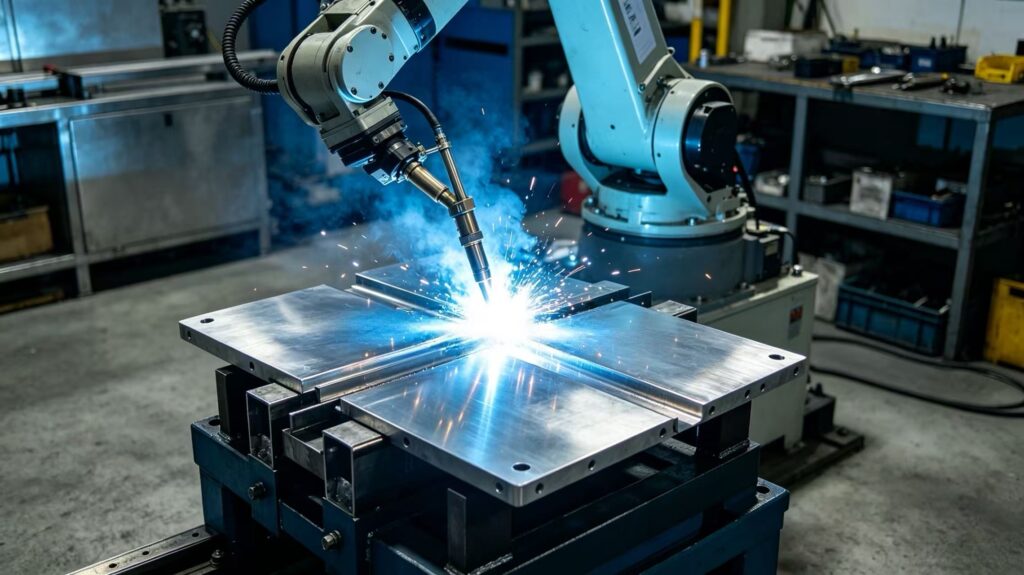
- El robot (programado por ingenieros) pasa un cordón sobre el mismo material, y sale negro, holliniento y sucio.
No te lo estás imaginando. La soldadura robótica de aluminio es más propensa a la “carbonilla negra” que la soldadura manual.
Pero, ¿por qué? ¿Carece el robot de “habilidad”? No. La respuesta está en la física, la cobertura de gas y los hábitos de programación.
En esta guía, desglosaremos exactamente por qué el aluminio se vuelve negro durante la soldadura TIG de aluminio y cómo arreglar tu celda robótica para obtener resultados de acabado espejo.
¿Qué es esa “cosa negra” en el proceso de soldadura de aluminio? (No es carbono)
Primero, aclaremos un mito importante sobre la soldadura TIG de aluminio.
El residuo negro no es aluminio o carbono “quemado”.
En realidad es Vapor Metálico.
- La ciencia: El aluminio y el magnesio hierven a temperaturas mucho más bajas que el arco eléctrico.
- El proceso: El arco vaporiza el metal. Este vapor se eleva.
- El fallo: Si el vapor toca el oxígeno, se convierte en óxido de aluminio (Al²O³) y óxido de magnesio (MgO). .
- El color: Estos óxidos microscópicos dispersan la luz de manera diferente, haciéndolos parecer grises o negros al ojo humano.
Conclusión: Hollín negro = Vapor de metal sin protección.
La Diferencia Principal: Manual vs. Robótico
En la Fabricación de Soldadura TIG de Aluminio, ¿por qué un humano puede soldar limpiamente, pero un robot produce hollín? Se reduce a tres variables: Ángulo del Soplete, Distancia de Salida y Adaptabilidad.
El Desastre de “Empujar” vs. “Arrastrar” (Ángulo del Soplete)
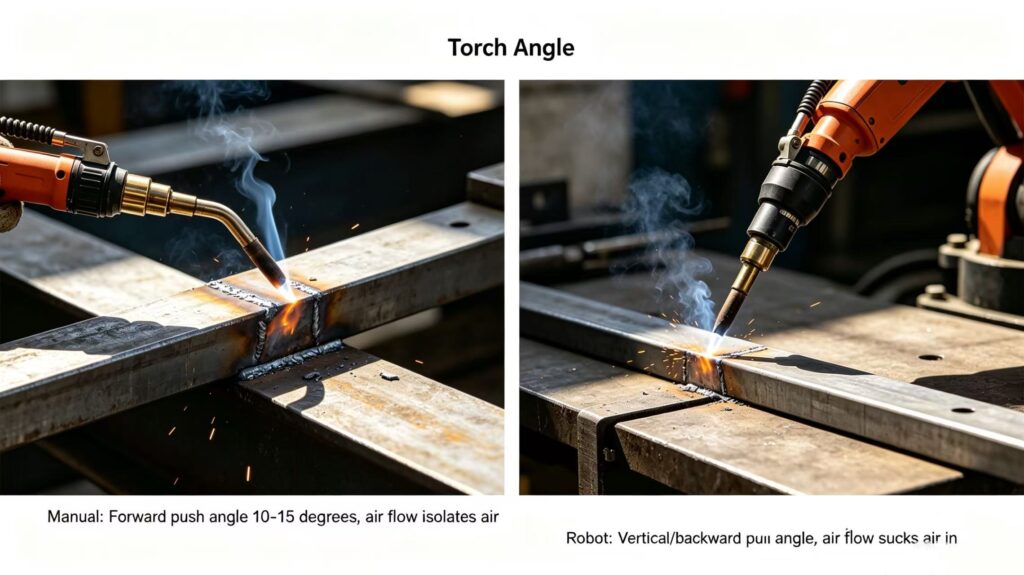
- El soldador manual (inteligente): Un soldador experimentado siempre usa un “ángulo de empuje”. Apuntan la antorcha hacia adelante (10-15 grados). Esto crea un colchón aerodinámico que aleja el aire del charco de soldadura.
- El robot (literal): Muchos programas robóticos son enseñados por ingenieros que no sueldan. A menudo usan un “ángulo de arrastre” (tirando de la antorcha) o un ángulo perpendicular. Esto crea un efecto Venturi que succiona el aire circundante hacia el escudo de gas. Aire + Vapor = Hollín negro.
La “Distancia de la Punta de Contacto a la Pieza de Trabajo” (CTWD)
- El soldador manual: Un humano mantiene la boquilla increíblemente cerca del metal, generalmente alrededor de ½ pulgada (12 mm). Si la brecha crece, instintivamente la empujan de vuelta.
- El robot: Un robot sigue una trayectoria rígida. Si tu fijación está ligeramente deformada o la pieza no está sujeta perfectamente, la antorcha se aleja. A ¾ de pulgada, el escudo de gas se vuelve turbulento. A 1 pulgada, no existe. El vapor se oxida instantáneamente.
Aporte de Calor y Quemado de Magnesio
- Manual: Un humano puede “acelerar” (moverse rápido) o reducir la velocidad según el charco. Regulan el calor dinámicamente.
- Robótico: Los robots a menudo funcionan a velocidades de avance constantes. Si la velocidad es demasiado lenta para el amperaje, sobrecalientas el charco. El sobrecalentamiento quema el magnesio (especialmente en el alambre ER5356), creando nubes de polvo negro de óxido de magnesio.
Cómo Arreglar la Soldadura Robótica de Aluminio (4 Pasos Accionables)
No necesitas despedir al robot. Solo necesitas reprogramarlo como un soldador.
Paso 1: Arregla el Ángulo (Cambia a Empuje)
Abre el colgante de enseñanza del robot inmediatamente.
- Cambio: Asegúrate de que la antorcha esté inclinada 10-15 grados en “empuje” (apuntando hacia la dirección del avance).
- Evita: Ángulos de 0 grados (perpendicular) o de “arrastre”.
- Resultado: La manta de gas permanece intacta.
Paso 2: Acorta la Distancia de Salida
- Cambio: Reprograma tus trayectorias para que la Distancia de Contacto de la Punta al Trabajo (CTWD) sea de un máximo de 12 a 15 mm.
- Consejo profesional: Si tu fijación está deformada, invierte en seguimiento de costura a través del arco o sensores táctiles. El robot debe adaptarse a la pieza, no al revés.
Paso 3: Cambia tus Ajustes de Gas
- Aumenta el flujo: Sube tu flujo de argón a 25-35 CFH (pies cúbicos por hora).
- Añade una lente de gas: Usa una lente de gas (tamiz) en la antorcha. Laminariza el flujo, haciéndolo “suave” y resistente a corrientes de aire, a diferencia de los cuerpos de pinza estándar que son turbulentos.
Paso 4: Considera Cambiar el Metal de Aporte
Si el hollín negro no desaparece y la pieza no va a estar en agua salada:
- Cambia de ER5356 (base de Mg) a ER4043 (base de Si).
- Por qué: El 4043 casi no contiene magnesio. Produce prácticamente nada de hollín negro, aunque es ligeramente más blando y menos dúctil que el 5356.
Si tienes un problema de soldadura, piezas de soldadura TIG de aluminio personalizadas de Flow Wing Metal ¡Ahora! ¿Es la soldadura manual "mejor" que la robótica para el aluminio?
Servicios de Soldadura TIG de Aluminio Personalizada No. Un robot es más consistente y rápido. El problema es que la mayoría de los programas robóticos son escritos por programadores, no por soldadores.
El hollín negro es un problema de cobertura de gas.
· Los soldadores manuales arreglan la cobertura instintivamente.
- Los soldadores manuales corrigen la cobertura instintivamente.
- A los robots se les debe enseñar a hacer lo mismo.
· ¿Está el soplete empujando (no arrastrando)?
- ¿Está la antorcha empujando (no arrastrando)?
- ¿Está la boquilla a menos de ½ pulgada del metal?
- ¿Es el flujo de argón lo suficientemente alto (25+ CFH)?
- ¿Tienes una lente de gas instalada?
- ¿Has probado el alambre 4043 como prueba?

Arregla estas cuatro variables, y tu soldadura de aluminio robótica se verá igual de brillante—y mucho más repetible—que la de tu mejor soldador manual.
—
Nos especializamos en resolver problemas de oxidación y hollín para la fabricación automatizada. para un presupuesto.¿Por qué la soldadura de aluminio se vuelve negra? Por qué la soldadura robótica de aluminio decolora más el aluminio: 4 Causas y 3 Soluciones Comprobadas para soldaduras limpias. - tigweldingaluminum.com. Contáctanos La soldadura de aluminio se vuelve negra.