
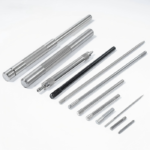
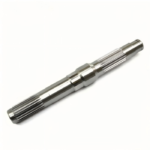

Spline Shafts 17 4 PH Stainless Steel Precision Custom OEM Shafts
Custom Spline Shafts machined from 17-4 PH stainless steel provide high strength, corrosion resistance and precise torque transmission for demanding industrial applications.
Request a Quote
Enter the quantity you need and add to your quote list for pricing inquiries.
Product Details
What Is a Spline Shaft?
A spline shaft is a mechanical component with longitudinal ridges (splines) that mesh with corresponding grooves in a mating part such as a gear, hub, or bearing. Unlike keyed shafts that use a single key to transmit torque, spline shafts distribute stress across multiple teeth, resulting in greater durability, higher load capacity, and superior torque transmission. The multiple contact points also provide better centering of the shaft, reducing vibration and wear.
The spline shaft is characterized by its spline profile, tooth geometry, and overall dimensions. Typical features include precision-ground spline teeth for smooth engagement, heat-treated surfaces for wear resistance, and end machining for mounting. Spline shafts are available in various profiles including involute, straight-sided, serrated, and helical types, each offering specific advantages for different applications.

Why Choose Custom CNC Machined Spline Shafts?
Off-the-shelf spline shafts may not always fit your specific application. Standard lengths, spline profiles, or materials may not align with your design requirements. Custom CNC machined spline shafts provide the perfect solution for applications requiring precise fitment.
With CNC machining, every aspect of the spline shaft can be customized. The spline profile can be matched to your specific requirements. The length can be adjusted for your assembly. The material can be selected for strength, corrosion resistance, or weight. Heat treatment can be tailored for durability. Additional features such as threaded ends, keyways, or cross-holes can be added.
Our CNC machining process ensures that each spline shaft achieves tight tolerances, typically within ±0.01mm, with excellent surface finish and consistent quality across every part, from prototypes to high-volume production runs.
Materials for Custom Spline Shafts:
The choice of material for a spline shaft depends on load requirements, operating environment, and wear resistance needs.
Alloy Steel (4140, 4340) is the most common material for spline shafts. These grades offer high strength, excellent fatigue resistance, and good wear resistance after heat treatment. They are suitable for automotive drivelines, industrial gearboxes, and heavy machinery.
Carbon Steel (1045, 1144) provides good strength at lower cost. Suitable for light to medium-duty applications where extreme wear resistance is not required.
Stainless Steel (303, 304, 316) offers corrosion resistance for marine, food processing, and medical applications.
Titanium provides exceptional strength-to-weight ratio and outstanding corrosion resistance. Ideal for aerospace and high-performance applications.
Inconel offers high-temperature strength and corrosion resistance for extreme environments such as jet engines and gas turbines.
Spline Profiles:
Involute splines are the most common profile and are standardized for high-load applications. The tapered teeth reduce stress concentration and provide smooth engagement. This profile is widely used in automotive transmissions and industrial gearboxes.
Straight-sided splines are simpler to produce but less efficient than involute splines. They are suitable for lower torque applications where cost is a primary concern.
Serrated splines are designed for precision alignment rather than high torque transmission. They are often used in positioning and indexing applications.
Helical splines offer smooth torque transfer and accommodate axial movement. They are ideal for aerospace systems and robotics where smooth motion is critical.
Manufacturing Process:
The production of a spline shaft follows a precise sequence of operations depending on the spline type and required precision.
Hobbing uses a spline hob on a milling or gear hobbing machine to cut splines. This method offers high productivity and accuracy, suitable for mass production of involute splines.
Milling uses a special forming cutter on a universal milling machine. This method is suitable for single piece and small batch production where tooling cost is a concern.
Grinding uses a formed grinding wheel for hardened spline shafts or shafts requiring higher precision. This method achieves the tightest tolerances and finest surface finishes.
Cold beating (also known as spline rolling) is a plastic deformation method that forms splines through high-speed hammering. Efficiency is about 5 times higher than milling and produces a work-hardened surface.
Applications of Custom Spline Shafts:
Automotive Drivelines:
Spline shafts play a critical role in transmissions, differentials, transfer cases, and driveshaft assemblies. Their toothed profile allows efficient torque transmission while accommodating limited axial movement, helping ensure smooth and reliable power delivery.
Industrial Gearboxes:
These power transmission components are widely used to connect electric motors, reducers, and gearbox assemblies in heavy-duty industrial equipment. Common applications include conveyors, pumps, compressors, packaging machinery, and machine tools.
Aircraft Systems:
Precision-machined spline shafts are utilized in flight control systems, landing gear mechanisms, engine accessory drives, and other aerospace applications where strength, reliability, and dimensional accuracy are essential.
Robotics:
High-precision drive components support accurate motion transfer in robotic arms, servo actuators, automated positioning systems, and industrial automation equipment, contributing to repeatable and precise movement control.


Our CNC Machining Capabilities:
Our facility is equipped with advanced CNC turning and milling centers capable of producing spline shafts to the highest standards. We offer spline hobbing, broaching, grinding, and heat treatment services all in-house. We support prototype quantities as low as one piece and production runs of thousands. Our quality control includes dimensional inspection, hardness testing, and surface finish verification.
Frequently Asked Questions:
Q: What is a spline shaft used for?
A: A spline shaft is designed to transmit torque between connected components while allowing axial movement when required. It is commonly used in driveline, gearbox, transmission, and industrial power transmission systems.
Q: What materials can be used for spline shafts?
A: Common materials include 4140 alloy steel, 4340 alloy steel, stainless steel, titanium, and Inconel. Material selection depends on load requirements, operating environment, and temperature conditions.
Q: What is the difference between involute and straight-sided splines?
A: Involute splines feature a standardized tooth profile that distributes load more evenly and reduces stress concentration. Straight-sided splines are simpler in design but are generally used in less demanding applications.
Q: What tolerances can you achieve on spline shafts?
A: We can machine spline shafts to tolerances as tight as ±0.01 mm and achieve surface finishes down to Ra 0.4 μm for precision applications.
Q: Do you provide heat treatment services?
A: Yes. We offer carburizing, induction hardening, nitriding, and through-hardening processes to improve wear resistance and extend service life.
Conclusion:
A spline shaft is a critical component for power transmission systems, enabling torque transfer with axial movement capability. When off-the-shelf options do not meet your needs, custom CNC machined spline shafts provide the perfect solution. With our precision machining capabilities, material options, and commitment to quality, we deliver shafts that fit perfectly and perform reliably.