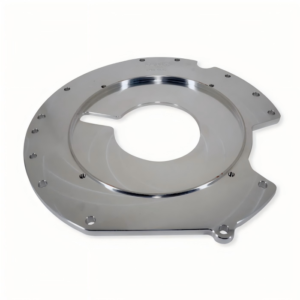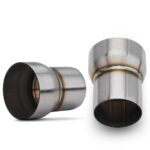

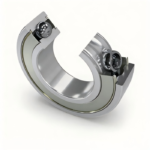


Ball Race Bearing 2″ OD 440C SS Angular Contact Custom Bearing
Ball Race Bearing offers precision-engineered bearing solutions with durable materials, smooth operation, and reliable performance for industrial applications.
Request a Quote
Enter the quantity you need and add to your quote list for pricing inquiries.
Product Details
Ball race bearing – custom CNC machined. 52100 steel, stainless, or ceramic. Any bore size, any ball count. Precision ground raceways.
What Is a Ball Race Bearing?
A ball race bearing is a rolling-element bearing that uses spherical balls to maintain separation between the bearing races. The fundamental design includes an inner race (attached to the rotating shaft) and an outer race (attached to the stationary housing), with balls positioned in the circular groove between them. This configuration allows for smooth rotational movement and helps to bear both radial and axial loads.
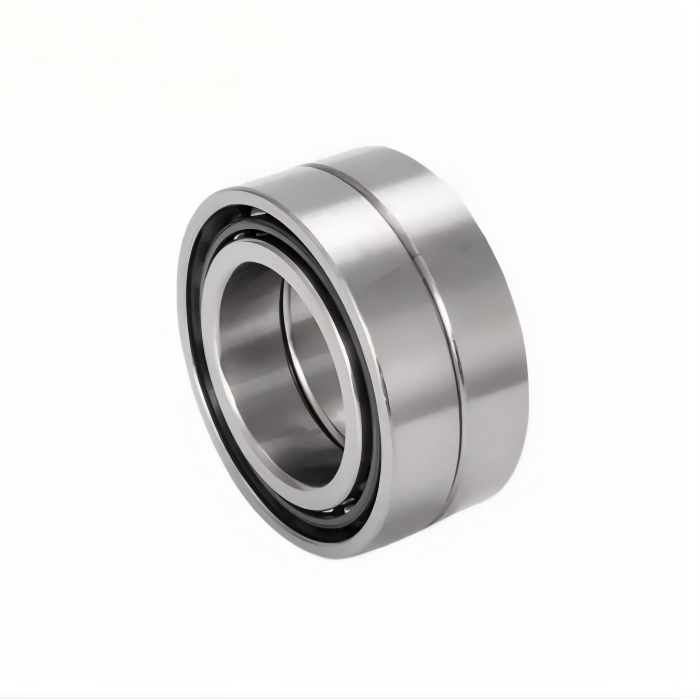
The ball race bearing is characterized by its precision-ground raceways, ball complement, and cage design. Typical features include hardened steel raceways for wear resistance, precision-ground balls for smooth operation, and a cage or retainer to maintain ball spacing. Common designs include deep-groove Conrad bearings, angular contact bearings, and thrust ball bearings. The ball race bearing is one of the most widely used bearing types due to its versatility, low friction, and ability to handle both radial and axial loads.

How a Ball Race Bearing Works:
The ball race bearing operates on the principle of rolling contact. As the shaft rotates, the inner race rotates with it. The balls roll between the inner and outer races, transmitting load from the rotating shaft to the stationary housing. The rolling action of the balls significantly reduces friction compared to sliding contact, enabling higher speeds and longer service life.
The contact angle between the balls and raceways determines the bearing’s load-carrying capability. Radial ball bearings have a contact angle of zero degrees and primarily carry radial loads. Angular contact bearings have a contact angle greater than zero, allowing them to carry combined radial and axial loads. The larger the contact angle, the higher the axial load capacity.
The raceway curvature (conformity) affects the contact stress distribution between the ball and race. Typical conformity is in the range of 0.95 to 0.97, balancing load capacity with friction.
Why Choose Custom CNC Machined Ball Race Bearings?
Off-the-shelf ball race bearings may not always fit your specific application. Standard bore sizes, outer diameters, or ball complements may not align with your load or speed requirements. Custom CNC machined ball race bearings provide the perfect solution for applications demanding precise fitment and optimal performance.
With CNC machining, every aspect of the ball race bearing can be customized to your exact specifications. The bore diameter can be precisely matched to your shaft. The outer diameter can be optimized for your housing. The ball complement can be configured for your load requirements. The material can be selected for strength, corrosion resistance, or high temperature operation.
Our CNC machining process ensures that each ball race bearing achieves tight tolerances, with excellent surface finish and consistent quality across every part, from prototypes to high-volume production runs.
Materials for Custom Ball Race Bearings:
The choice of material for a ball race bearing depends on load requirements, speed, and environmental conditions.
52100 Chrome Steel is the most common bearing material, valued for its mechanical strength, high hardness, and excellent wear resistance. It is suitable for most industrial applications including automotive, machinery, and general purpose uses.
Stainless Steel (440C, 316) provides corrosion resistance for food processing, pharmaceutical, and marine applications. 440C offers good hardness and wear resistance while resisting rust.
Ceramic (Y-TZP Zirconia, Si3N4) offers higher stiffness, lower density, and reduced friction compared to steel. Full ceramic ball bearings require less lubrication and offer excellent wear and corrosion resistance. They are ideal for high-speed and high-temperature applications.
Hybrid Bearings feature steel races with ceramic balls. This combination offers the strength of steel races with the low friction and high-speed capability of ceramic balls.
Types of Ball Race Bearings:
Radial Ball Bearing:
Designed to carry loads perpendicular to the axis of rotation. This is the most common type with one row of balls. It can also support modest axial loads. Suitable for general industrial applications.
Angular Contact Bearing:
Features offset races that allow combined radial and axial loads. The larger the contact angle, the higher the axial load capacity. Commonly used in pairs for machine tool spindles.
Thrust Ball Bearing:
Designed for pure axial loads with two grooved plates and balls between. Also known as axial ball bearings. Suitable for applications where axial loads are dominant.
Deep-Groove Conrad Bearing:
Assembled by offsetting the inner and outer races radially and inserting balls through the gap. This is the most familiar industrial ball bearing design.
Split Race Bearing:
Features one race split into two segments to allow more balls for increased load capacity. Suitable for high-load applications.
Applications of Custom Ball Race Bearings:
Automotive:
Ball race bearings are used in wheels, transmissions, engines, and steering systems. They enable smooth rotation and reduce friction in critical vehicle components.
Aerospace:
Ceramic ball bearings are used in turbines, jet engines, and control systems where high temperature and low centrifugal force are critical.
Industrial Machinery:
Ball race bearings are integral to conveyors, pumps, mixers, and textile equipment. They ensure reliable operation in demanding industrial environments.
Medical and Food Industries:
Full ceramic ball bearings are preferred due to their corrosion resistance and minimal lubrication requirements.
Robotics and Automation:
Precision ball race bearings enable accurate motion control in robotic arms and automated systems.

Frequently Asked Questions:
Q: What is the difference between a bearing and a race?
A: The race is the grooved ring (inner or outer) that the balls roll against. The bearing is the complete assembly including races, balls, and cage.
Q: What are ball race bearings made of?
A: Most are made from 52100 chrome steel. Ceramic materials like silicon nitride and zirconia are used for high-speed and corrosion-resistant applications.
Q: What is a Conrad bearing?
A: A Conrad bearing is assembled by offsetting the inner and outer races to insert balls, then distributing them around the bearing. It handles both radial and axial loads.
Q: What materials can you provide?
A: We can machine bearing races from steel, stainless steel, and ceramic materials. Material selection depends on your load, speed, and environment requirements.
Q: What tolerances can you hold?
A: We hold tight tolerances on critical dimensions including bore diameter, raceway profile, and ball groove geometry.
Conclusion:
A ball race bearing is a critical component for reducing friction and supporting loads in rotating machinery. When off-the-shelf options do not meet your needs, custom CNC machined ball race bearings provide the perfect solution.