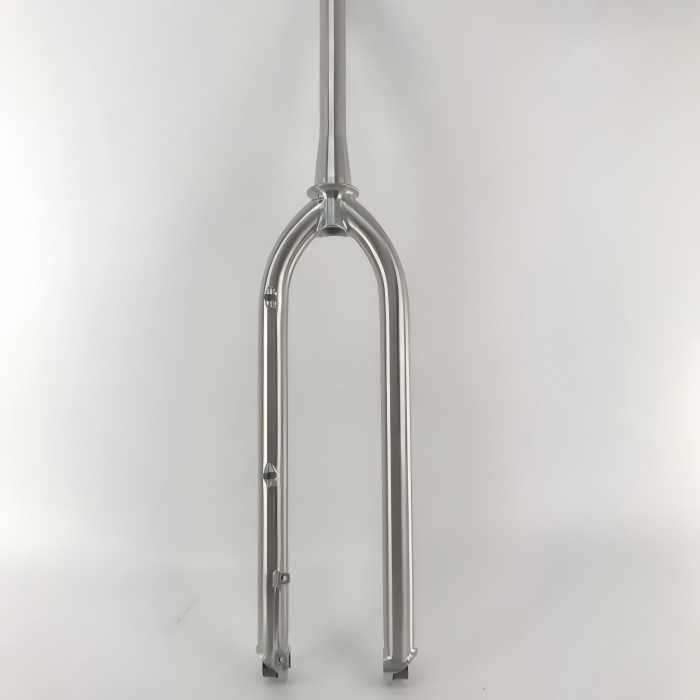
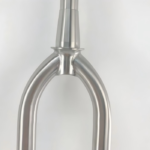
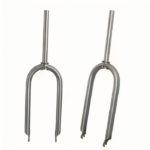
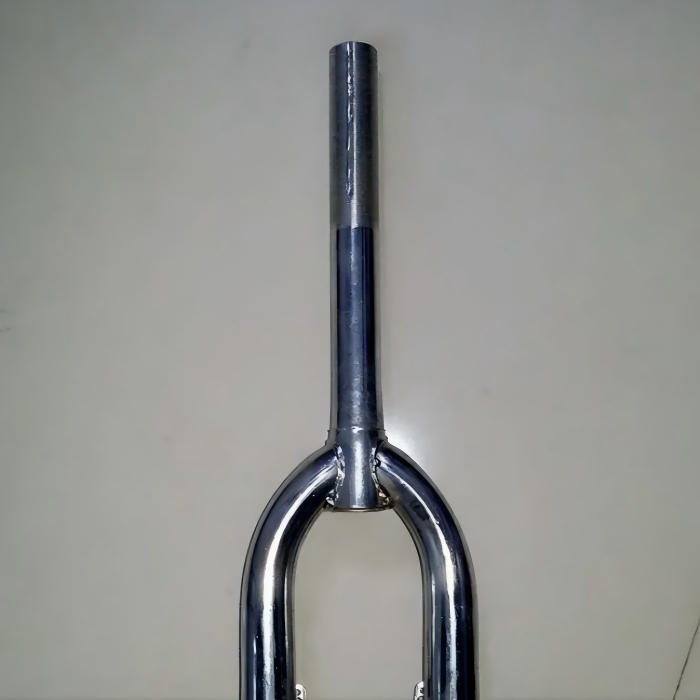
Superior Titanium Mountain Bike Fork TIG Welding Service Assembly
Questa forcella per mountain bike in titanio è fabbricata su misura con tecnologia di saldatura TIG di precisione per applicazioni MTB premium.
Request a Quote
Enter the quantity you need and add to your quote list for pricing inquiries.
Product Details
Why Consider a Rigid Titanium Mountain Bike Fork?
Most mountain bikes come equipped with suspension forks. These forks offer comfort and control on rough terrain but come with significant drawbacks. Suspension forks are heavy, typically weighing four to six pounds. They require regular maintenance including oil changes, seal replacements, and bushing inspections. They also have a limited lifespan, with most needing a complete overhaul or replacement after a few seasons of hard riding.
A rigid titanium mountain bike fork eliminates these issues. Without moving parts, there is nothing to service or replace. Weight drops dramatically, often to two pounds or less. The bike becomes more efficient on climbs and smoother on rolling terrain. While a rigid titanium mountain bike fork does not absorb large impacts like a suspension fork, it does offer natural vibration damping that aluminum and carbon cannot match.
The Titanium Advantage for Mountain Bike Forks:
Titanium offers four distinct advantages for fork applications. First, vibration damping. Titanium has a natural ability to absorb high-frequency vibration. A titanium mountain bike fork transmits less trail chatter to the rider’s hands and arms compared to aluminum or carbon. This reduces fatigue on long rides.
Second, strength and durability. Titanium has an exceptional strength-to-weight ratio. A properly designed titanium mountain bike fork can withstand the forces of aggressive trail riding without bending or cracking. The material also has excellent fatigue resistance, meaning it will not fail after thousands of miles of use.
Third, corrosion resistance. Titanium forms a stable oxide layer that protects against all forms of corrosion. A titanium mountain bike fork will never rust, even after years of exposure to mud, rain, and road salt. No paint or coating is required.
Quarto, qualità di guida. Molti ciclisti descrivono la sensazione di una forcella per mountain bike in titanio come vivace ma stabile. La forcella flette leggermente sotto carico, offrendo un grado di cedevolezza che l'alluminio non può fornire, poi ritorna in posizione senza deformazione permanente.
Caratteristiche di Progettazione di una Forcella per Mountain Bike in Titanio di Qualità:
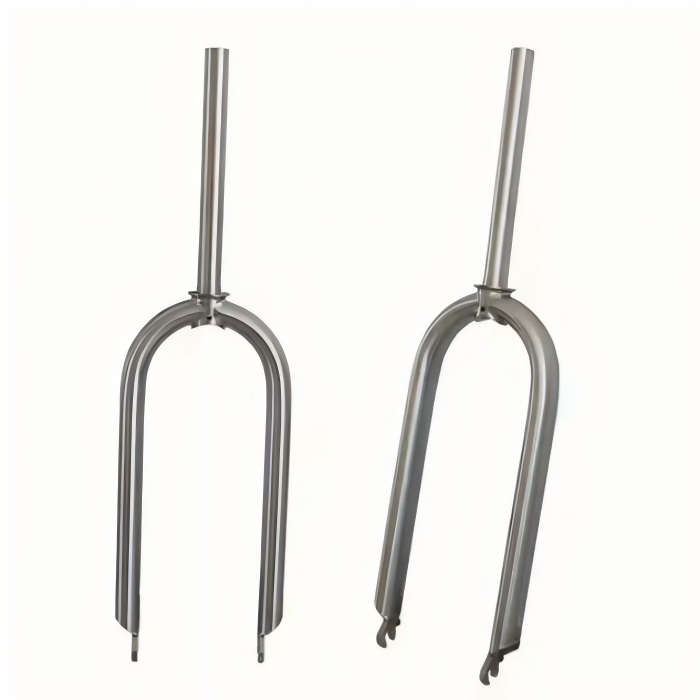
Una forcella per mountain bike in titanio ben progettata include diverse caratteristiche importanti. Il diametro del tubo sterzo deve corrispondere al cannotto e al telaio del ciclista. Gli standard comuni includono 1-1/8 pollici dritto, conico da 1-1/8 a 1-1/4 pollici e conico da 1-1/8 a 1,5 pollici.
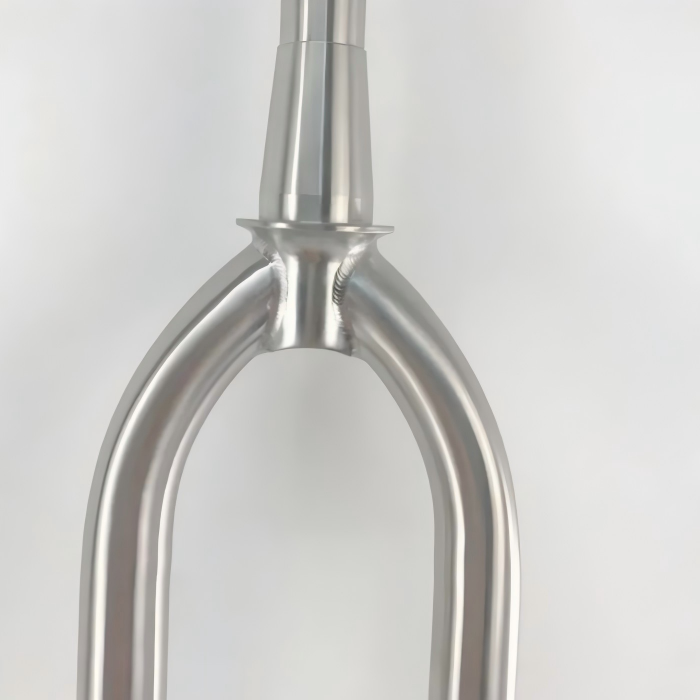
Il design della corona è fondamentale. La corona collega il tubo sterzo ai foderi della forcella. Su una forcella per mountain bike in titanio, la corona è tipicamente realizzata in lamiera di titanio o lavorata da un blocco solido. La corona deve essere abbastanza rigida da resistere alla torsione durante frenate brusche e curve.
Il diametro dei foderi e lo spessore della parete determinano rigidità e peso. I diametri tipici dei foderi per una forcella per mountain bike in titanio vanno da 28 mm a 32 mm. Lo spessore della parete varia da 0,9 mm a 1,5 mm a seconda del peso del ciclista e dell'uso previsto.
I forcellini alle estremità della forcella devono essere allineati con precisione. Una forcella per mountain bike in titanio con forcellini disallineati farà sì che la ruota anteriore sia inclinata, influenzando la maneggevolezza e l'usura del pneumatico. I forcellini sono spesso lavorati da barre di titanio e saldati ai foderi della forcella.
Sfide della Saldatura di una Forcella per Mountain Bike in Titanio:
Il titanio presenta serie sfide di fabbricazione. Il titanio è altamente reattivo quando esposto a ossigeno, azoto e idrogeno a temperature elevate. Durante la saldatura di una forcella per mountain bike in titanio, ogni zona di saldatura deve essere completamente schermata dalla contaminazione atmosferica. Se la schermatura fallisce, il titanio assorbe questi elementi, provocando infragilimento e cricche.
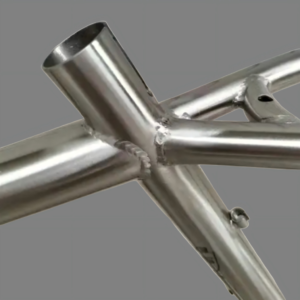
A mountain bike fork involves critical welds at the crown-to-steerer junction, crown-to-leg junctions, and leg-to-dropout junctions. Each of these welds must be fully penetrated and properly shielded. A failure at any of these joints could cause catastrophic fork failure while riding.
2. The crown area is particularly challenging. Multiple tubes converge at the crown, creating complex weld geometry. For a titanium mountain bike fork, each weld must be sequenced carefully to control heat input and prevent distortion. Back-purging is essential for all tube-to-tube joints.
3. Critical Steps for Welding a Titanium Mountain Bike Fork:
4. Successful fabrication of a titanium mountain bike fork begins long before the arc is struck:
5. Material selection: Grade 2 commercially pure titanium or Grade 9 (3Al-2.5V) titanium is commonly used for a titanium mountain bike fork. Grade 2 offers excellent vibration damping and weldability. Grade 9 provides higher strength for aggressive riding.
6. Fit-up: For a titanium mountain bike fork, joint gaps should not exceed 0.3mm. Use fixtures to maintain perfect alignment. Poor fit-up leads to weak welds and misalignment.
7. Back-purging: The inside of all tubes must be purged with pure argon at 99.999 percent purity. Without back-purging, the root side of each weld oxidizes, creating a brittle layer that will crack under riding loads.
8. Torch setup: Gas tungsten arc welding (GTAW/TIG) is the only process recommended for a titanium mountain bike fork. Use a 2 percent ceriated or lanthanated tungsten electrode. A gas lens improves coverage. Set post-flow to at least 15 seconds.
9. Heat control: Titanium forks require precise heat input. Too little heat produces incomplete penetration. Too much heat causes burn-through or distortion. Many builders pulse the foot pedal to control the weld pool.
10. Common Defects in Titanium Mountain Bike Fork Welding:
11. Even experienced welders may encounter defects when fabricating a titanium mountain bike fork:.
The crown area is particularly challenging. Multiple tubes converge at the crown, creating complex weld geometry. For a titanium mountain bike fork, each weld must be sequenced carefully to control heat input and prevent distortion. Back-purging is essential for all tube-to-tube joints.
Critical Steps for Welding a Titanium Mountain Bike Fork:
Successful fabrication of a titanium mountain bike fork begins long before the arc is struck:
Material selection: Grade 2 commercially pure titanium or Grade 9 (3Al-2.5V) titanium is commonly used for a titanium mountain bike fork. Grade 2 offers excellent vibration damping and weldability. Grade 9 provides higher strength for aggressive riding.
Preparazione del tubo: I tubi in titanio devono essere tagliati con precisione, sbavati e puliti all'interno e all'esterno. Utilizzare acetone o alcol isopropilico seguito da una spazzola in acciaio inossidabile dedicata, usata solo sul titanio. Qualsiasi contaminazione porta a difetti di saldatura.
Fit-up: For a titanium mountain bike fork, joint gaps should not exceed 0.3mm. Use fixtures to maintain perfect alignment. Poor fit-up leads to weak welds and misalignment.
Back-purging: The inside of all tubes must be purged with pure argon at 99.999 percent purity. Without back-purging, the root side of each weld oxidizes, creating a brittle layer that will crack under riding loads.
Torch setup: Gas tungsten arc welding (GTAW/TIG) is the only process recommended for a titanium mountain bike fork. Use a 2 percent ceriated or lanthanated tungsten electrode. A gas lens improves coverage. Set post-flow to at least 15 seconds.
Heat control: Titanium forks require precise heat input. Too little heat produces incomplete penetration. Too much heat causes burn-through or distortion. Many builders pulse the foot pedal to control the weld pool.
Common Defects in Titanium Mountain Bike Fork Welding:
Even experienced welders may encounter defects when fabricating a titanium mountain bike fork:
Ossidazione e scolorimento: saldature argentate o color paglierino chiaro indicano una corretta schermatura. Blu, viola o grigio significano contaminazione che richiede il rigetto della saldatura. Una forcella per mountain bike in titanio ossidata non è sicura da guidare.
Penetrazione incompleta: La saldatura non si lega completamente attraverso lo spessore del tubo. Questo crea giunti deboli che possono cedere improvvisamente. Regolare i parametri e riqualificare la procedura di saldatura.
.
Sottosquadro: Un solco fuso nel metallo di base adiacente alla saldatura. Questo crea un concentratore di tensioni e un potenziale punto di innesco di cricche. Ridurre l'amperaggio o regolare la tecnica.
.
Distorsione: Il calore fa espandere e contrarre il titanio. Una forcella per mountain bike in titanio può deformarsi e perdere l'allineamento se le saldature vengono eseguite nella sequenza sbagliata. Utilizzare dime e passate di saldatura alternate.
.
Applicazioni e Profili dei Ciclisti:
Una forcella per mountain bike in titanio attrae diversi tipi di ciclisti. I corridori di cross-country apprezzano il risparmio di peso e l'efficienza in salita. I bikepacker e gli avventurieri apprezzano l'affidabilità e l'assenza di manutenzione. Gli appassionati di bici a scatto fisso e rigide preferiscono la semplicità e la sensazione diretta.
.
Anche i restauratori di mountain bike d'epoca cercano forcelle in titanio per sostituire l'attrezzatura originale usurata, mantenendo un'estetica classica.
.
Perché Scegliere Specialisti della Saldatura del Titanio per la Tua Forcella?
Fabbricare una forcella per mountain bike in titanio non è un lavoro per un'officina di saldatura generica. Uno specialista utilizza un'area di lavoro pulita e isolata dall'acciaio. Mantiene registri della purezza del gas e utilizza tecniche di spurgo posteriore adeguate. Comprende la dilatazione termica unica del titanio e sequenza le saldature per ridurre al minimo la distorsione.
.
Inoltre, uno specialista può offrire assistenza nella progettazione. Il diametro delle gambe, lo spessore della parete, la geometria della corona e l'angolo di inclinazione devono essere ottimizzati per il titanio. Un partner esperto ti aiuterà a evitare errori comuni.
.
Conclusione:
Una forcella per mountain bike in titanio rappresenta un'opzione unica per i ciclisti che apprezzano la durata, il risparmio di peso e la qualità di guida rispetto alla complessità delle sospensioni. Quando saldata correttamente da professionisti esperti, offre anni di servizio affidabile senza manutenzione. Per i ciclisti che sanno cosa vogliono, il titanio è una scelta eccellente.
.