


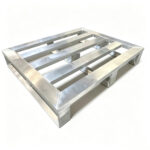
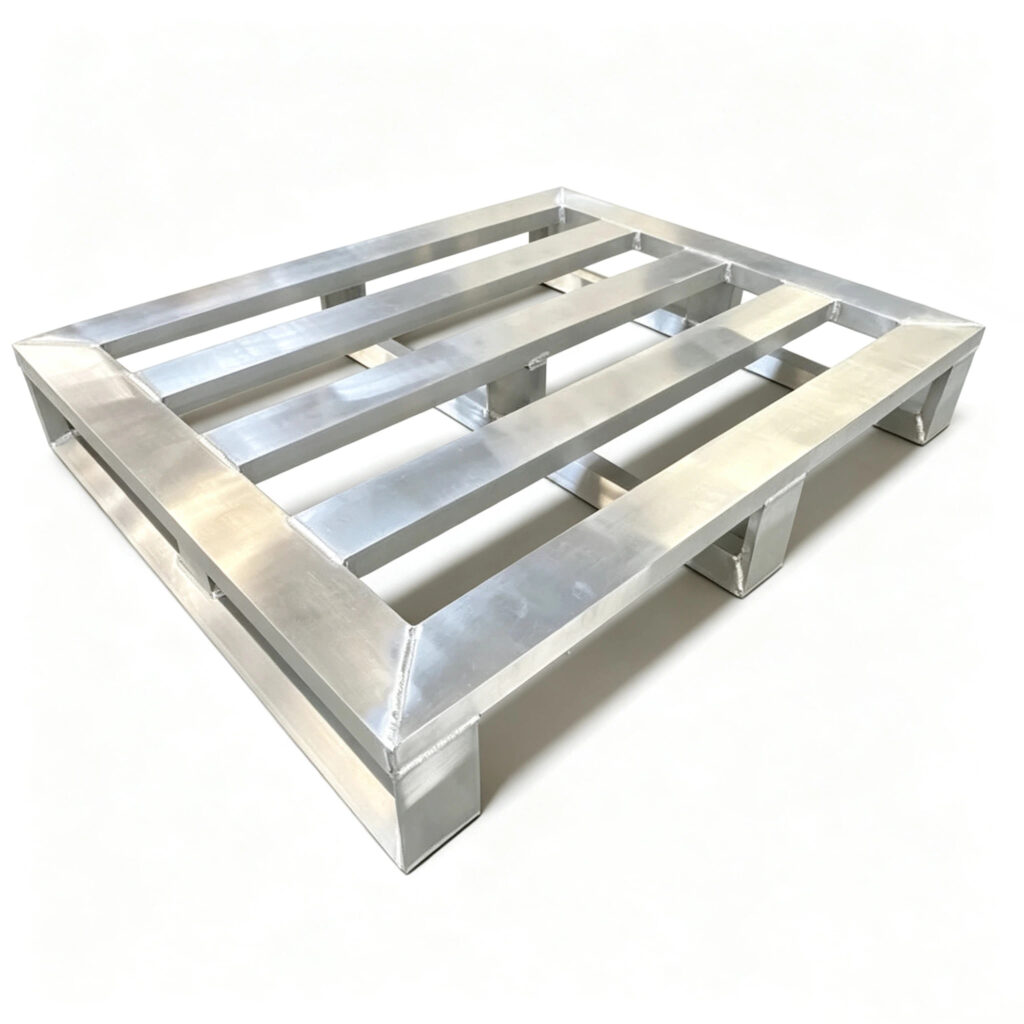
Aluminum Pallet 4-Way Entry Smooth Surface for Conveyor Systems
Custom aluminum pallets designed for industrial handling and logistics applications, offering lightweight strength, and durable performance.
Request a Quote
Enter the quantity you need and add to your quote list for pricing inquiries.
Product Details
Welding Service Flow for Aluminum Pallet Production:
Our welding service for aluminum pallet manufacturing follows a rigorous, multi-stage process to ensure structural integrity and dimensional precision. Each step is executed by our certified welding team with decades of combined experience.
- Material Incoming Inspection: All aluminum alloys (6061-T6, 5083, etc.) are verified for grade compliance and surface quality before entering production.
- CNC Tube Bending: Precision CNC tube bending creates consistent radii and angles for pallet frames, minimizing stress points and ensuring repeatability across batches.
- Fixture Setup & Alignment: Custom tooling fixtures hold components in exact position during welding to maintain flatness and squareness within ±0.5mm tolerance.
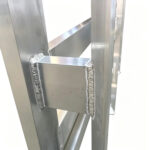
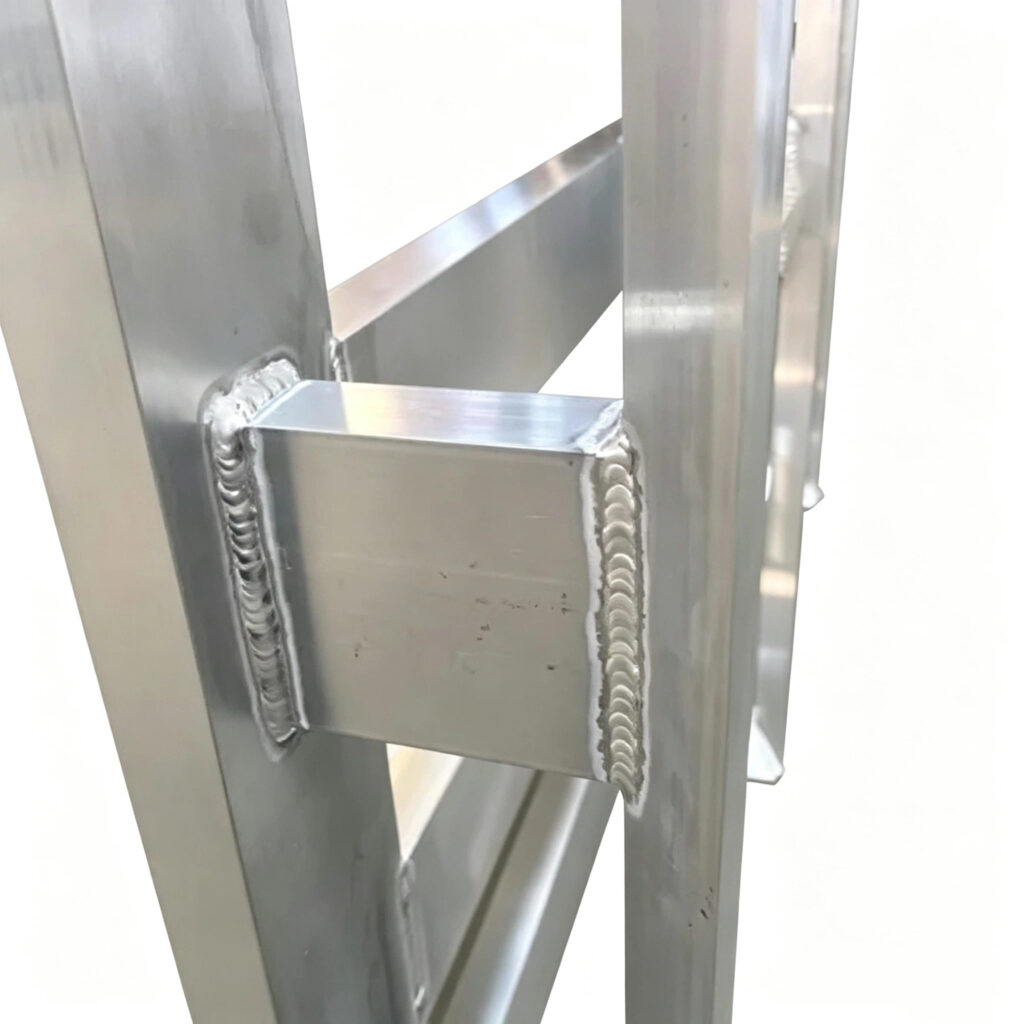
- Welding Execution: Our certified welders employ pulsed MIG and AC TIG processes, selecting optimal parameters for each alloy to achieve full penetration without burn-through.
- In-Process Inspection: Weld seams are visually inspected and dimensionally checked at designated hold points to catch deviations early.
- Post-Weld Stress Relief: Controlled cooling and, where specified, thermal treatment reduce residual stresses that could cause distortion over time.
- Final Dimensional Verification: Every aluminum pallet undergoes full measurement against customer drawings using calibrated gauges and CMM equipment.
- Surface Preparation & Finishing: Deburring, edge blending, and surface cleaning prepare the pallet for final coating or anodizing as required.
With 20+ certified welders experienced in aluminum fabrication, we deliver consistent, code-quality welding for every aluminum pallet that leaves our shop.
Advantages of Custom Welding for Aluminum Pallets:
- Optimized Wall Thickness Selection: We analyze load requirements to recommend ideal tube gauges – typically 2.0mm–4.0mm – balancing strength and weight reduction.
- Full-Penetration Joint Design: All critical load-bearing joints are designed with bevel preparations to achieve 100% joint penetration, eliminating weak spots that compromise structural life.
- Distortion Control Through Sequencing: Our welding sequence planning reduces angular distortion by up to 60% compared to conventional approaches, ensuring flat decks and parallel rails.
- Custom Fixturing for Repeatability: Dedicated tooling maintains consistent part positioning across production runs, holding critical dimensions to ±0.5mm for trouble-free assembly in automated lines.
- Process Parameter Documentation: Every weld parameter – amperage, voltage, travel speed, and gas flow – is recorded for traceability, enabling rapid troubleshooting and process replication.
- Material-Matched Filler Metals: We select filler alloys (e.g., ER4043 for 6061, ER5356 for 5083) to match base material properties, maximizing joint strength and corrosion resistance.
- NDT-Ready Workmanship: Our weld quality consistently meets Level I acceptance criteria for visual and dye-penetrant inspection, giving you confidence for critical applications.
- Scalable Capacity: With 10 welding stations and 20+ certified operators, we handle volumes from prototype runs to full container-load production without compromising quality.
Applications of Aluminum Pallets:
- Cold Chain Logistics: Aluminum pallets maintain structural integrity at sub-zero temperatures without becoming brittle, making them ideal for frozen food and pharmaceutical cold storage facilities.
- Air Freight & Export Shipping: Lightweight construction reduces airfreight charges, while their non-wood composition eliminates fumigation requirements and ISPM 15 compliance costs.
- Food & Beverage Processing: Non-porous, corrosion-resistant surfaces prevent bacterial growth and are easy to sanitize, meeting HACCP and FDA standards for direct food contact.
- Automated Warehousing: Precise dimensional consistency ensures smooth operation on conveyor systems, AS/RS racks, and automated guided vehicle (AGV) transfer points.
- Pharmaceutical Manufacturing: Smooth, weld-free top decks (when specified) eliminate contamination traps and simplify cleanroom protocols.
- Chemical & Marine Environments: Aluminum’s inherent corrosion resistance outperforms steel in humid, salty, or chemically aggressive atmospheres, extending service life significantly.

Material Selection for Aluminum Pallets:
Standard Material Options:
We fabricate aluminum pallets from three primary alloy groups based on application demands:
- 6061-T6: The workhorse choice – offering excellent strength-to-weight ratio, good weldability, and cost-effectiveness for general-purpose pallets up to 2,500kg static load.
- 5083-H112: Preferred for marine and chemical environments – superior corrosion resistance in saltwater and acidic conditions, with maintained strength in welded areas.
- 6063-T5: For aesthetic or architectural applications – smooth surface finish, moderate strength, and excellent anodizing response when appearance matters.
Wall thickness ranges from 1.5mm for light-duty handling to 5.0mm for extra-heavy configurations. We also stock 5754 and 5052 alloys for specialized requirements upon request.
Surface Treatment & Finishing:
We offer multiple finishing options to match your operational environment:
- Mill Finish: Standard as-welded surface – suitable for indoor dry storage where corrosion risk is minimal.
- Shot Blasting / Mechanical Polishing: Removes weld discoloration and surface oxides, creating a uniform matte or bright appearance.
- Anodizing (Type II / Type III): Adds a hard, abrasion-resistant ceramic layer – available in clear or colored finishes – significantly improving scratch and wear resistance.
- Powder Coating: Applied over a chromate pretreatment – offers excellent impact resistance and a wide color range for brand identification or warehouse zoning.
- Chemical Conversion Coating (Alodine): A thin, conductive coating that provides corrosion protection while maintaining electrical grounding properties – ideal for electronics-handling pallets.
All finishing processes are subcontracted to certified partners with full quality documentation.
Client Case Study: Aluminum Pallet for a Global Cold Chain Operator
Background: A multinational logistics provider faced recurring issues with wooden pallets in their -25°C frozen distribution centers – splintering, moisture absorption, and weight variability caused conveyor jams and product damage.
Challenge: They needed 2,000 lightweight aluminum pallets capable of handling 1,800kg dynamic loads in sub-zero conditions, with consistent dimensions to fit automated racking systems. Delivery was required in three phased shipments over 10 weeks.
Our Solution: We designed a 6061-T6 pallet with 2.5mm wall thickness tube, featuring a reinforced perimeter frame and five cross-supports. CNC bending ensured all four corners matched within 0.3mm radius tolerance. Our welding sequence minimized distortion, achieving deck flatness within 1.0mm across the full length.
Results: The pallets have operated continuously for 28 months with zero structural failures. The client reports 40% reduction in conveyor jam incidents and 100% elimination of foreign object contamination from wood splinters. Based on this success, they have reordered 500 units annually for new facility expansions.