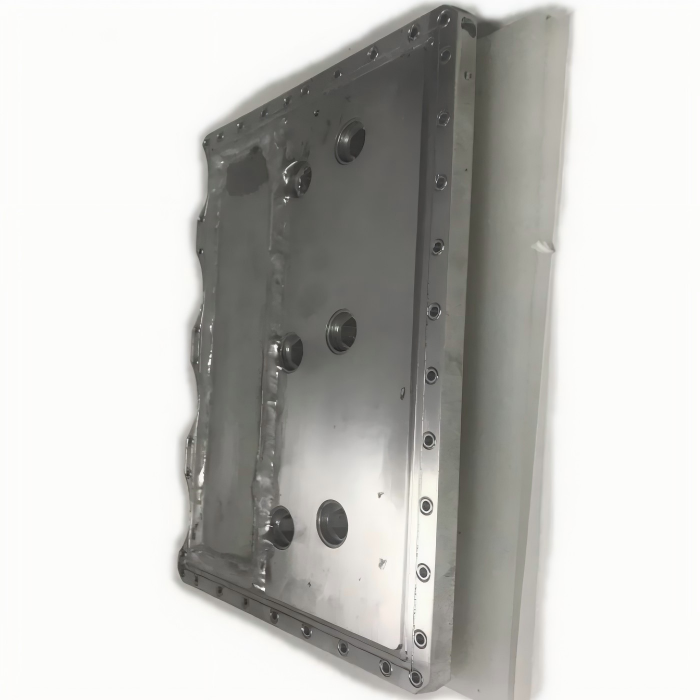

Custom Aluminum EV Battery Cooling Plate TIG Welded Assembly
TIG welded aluminum cooling plate custom-made for EV batteries. Ensures superior heat dissipation and long-term durability. Request samples today.
Request a Quote
Enter the quantity you need and add to your quote list for pricing inquiries.
Product Details
Why Aluminum for EV Battery Cooling Plates?
Aluminum is the undisputed material choice for battery thermal management. It offers high thermal conductivity, low density, and excellent formability. An ev battery cooling plate made from aluminum transfers heat away from cells up to five times faster than steel alternatives.
However, aluminum presents a specific challenge for cooling plate fabrication. The material’s high thermal conductivity also makes welding difficult. Heat dissipates rapidly, requiring advanced techniques like tig welding to achieve proper fusion without distortion. Our shop has mastered this process specifically for ev battery cooling plate production.
Thermal Conductivity Comparison
- Aluminum 6061: 167 W/m·K
- Steel: 50 W/m·K
- Stainless Steel: 15 W/m·K
An ev battery cooling plate made from aluminum removes heat rapidly, keeping cell temperatures within the optimal 15°C to 35°C range. This directly translates to faster charging speeds and longer battery cycle life.
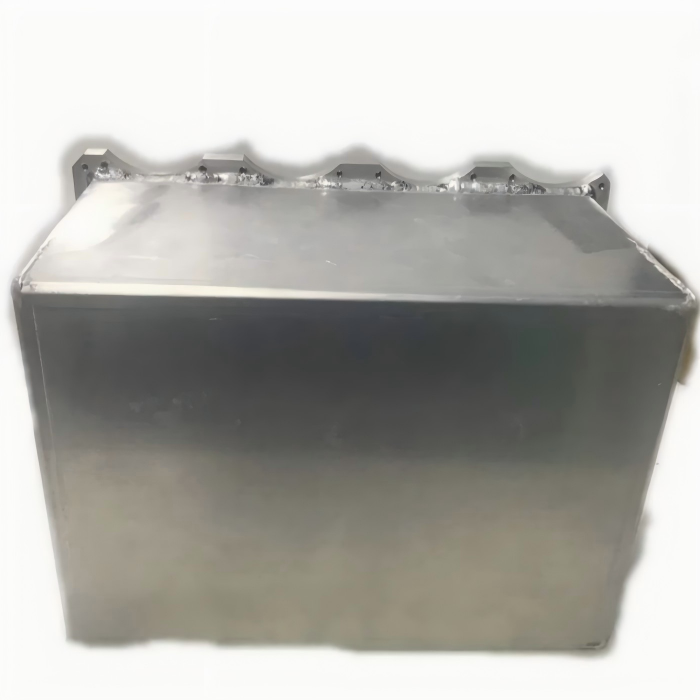
The TIG Welding Advantage for Cooling Plates:
Not all welding processes are suitable for an ev battery cooling plate. The component must carry liquid coolant through internal channels without any leakage over a 10+ year vehicle life. Weld defects as small as a pinhole will cause coolant loss and battery failure.
Why TIG Welding Outperforms Other Methods
MIG Welding deposits filler metal quickly but leaves microscopic porosity. For an ev battery cooling plate, that porosity creates leak paths over time as thermal cycling expands and contracts the material. MIG also produces spatter that must be removed from internal channels.
Brazing uses a lower-temperature filler that flows into joints by capillary action. While acceptable for some applications, brazed ev battery cooling plate joints lack the strength of a fusion weld. Vibration from vehicle operation eventually fatigues braze joints.
Laser Welding offers speed but requires perfect fit-up and expensive equipment. It also creates a very narrow heat-affected zone that can crack under thermal stress in aluminum.
TIG Welding solves all these problems. Our AC tig welding process with pulse control allows us to:
- Achieve full root penetration without burn-through on thin-gauge aluminum
- Create smooth, consistent weld beads with no porosity
- Control heat input to prevent warping of the ev battery cooling plate
- Use 4047 aluminum filler rod specifically formulated for leak-proof coolant joints
Every ev battery cooling plate leaving our shop undergoes 100% visual inspection and pressure testing. TIG welding gives us the control to produce plates that meet or exceed OEM leak standards.
Design and Construction of Our EV Battery Cooling Plate:
A properly designed ev battery cooling plate balances three competing requirements: coolant flow distribution, structural rigidity, and minimal weight. Our fabrication process addresses each systematically.
Core Construction:
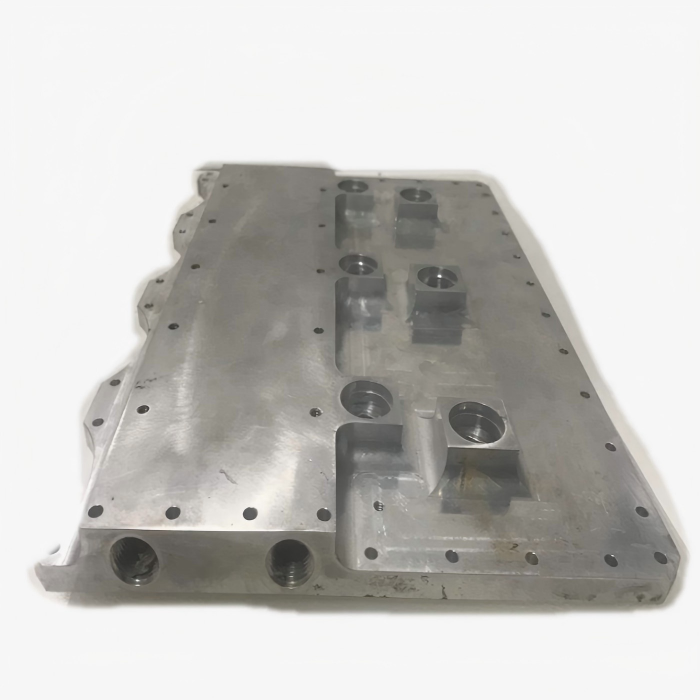
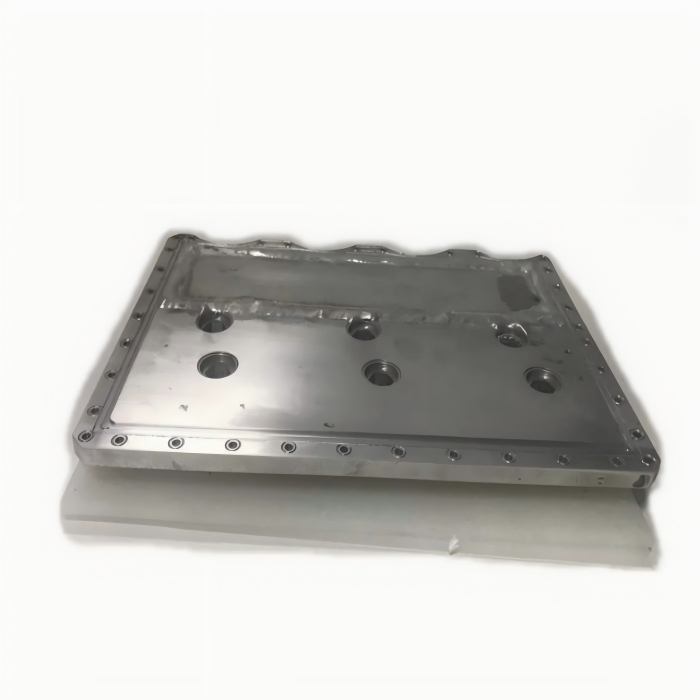
Our standard design utilizes a two-piece aluminum structure. A flat base plate, typically fabricated from 1.5 mm 6061 aluminum, is joined to a machined upper plate containing the coolant flow channels. TIG welding creates a continuous seal around the perimeter and internal channel boundaries, ensuring both structural strength and leak resistance.
Coolant Channel Geometry:
Channel layouts can be machined in either serpentine or parallel-flow configurations depending on battery module architecture and thermal management requirements. Typical channel widths range from 6 mm to 12 mm, with depths between 2 mm and 4 mm. The precision of the welding process helps maintain dimensional stability and consistent flow characteristics throughout the assembly.
Inlet and Outlet Ports:
Custom port locations are available to accommodate hose connections, quick-connect fittings, or specialized cooling system interfaces. Each port is attached using full-penetration TIG welds and undergoes pressure testing to verify leak-free performance. Standard testing is performed at pressures exceeding normal operating conditions to ensure long-term reliability.
Material Specifications:
| Component | Material | Thickness | Finish |
|---|---|---|---|
| Bottom plate | 6061-T6 aluminum | 1.5mm – 2.0mm | Mill finish |
| Top channel plate | 6061-T6 aluminum | 2.0mm – 3.0mm | Machined |
| Port fittings | 6061 aluminum bar stock | Custom | Machined threads |
| Filler rod | 4047 aluminum (11-13% silicon) | N/A | N/A |
The 4047 filler rod is specifically chosen for ev battery cooling plate applications. Its high silicon content reduces hot cracking and improves fluidity during tig welding, producing a completely sealed joint.
Custom Sizing for Any Battery Module:
Battery packs vary dramatically between vehicle manufacturers. A cooling plate for a Tesla Model S module differs completely from one for a Nissan Leaf or a commercial electric bus. We build each ev battery cooling plate to your specific dimensions.
Standard Capabilities:
- Length: 150mm to 1200mm
- Width: 100mm to 600mm
- Thickness (overall): 4mm to 15mm
- Channel count: 2 to 24 parallel channels
- Port orientation: Top, side, or end entry
We can produce an ev battery cooling plate for:
- Prismatic cell modules (the most common format)
- Cylindrical cell arrays (18650, 21700, 4680 cells)
- Pouch cell stacks (requires thinner, wider channels)
- Custom battery pack prototypes (one-off or low volume)
Unlike stamped plates that require expensive tooling for each design change, our TIG welded approach has no tooling costs. We can iterate your ev battery cooling plate design rapidly, producing a revised version within days of receiving updated CAD files.
Leak Testing and Quality Assurance:
A leaking ev battery cooling plate is catastrophic. Coolant contacting high-voltage components creates short circuits. Coolant loss leads to thermal runaway. We take quality control seriously.
Every plate undergoes three tests before shipping:
1. Visual Inspection under Magnification
All TIG welds are examined at 10x magnification. We look for crater cracks, undercut, insufficient fill, or any surface porosity. A single visible pore on an ev battery cooling plate triggers rejection.
2. Helium Leak Testing
We place the ev battery cooling plate in a vacuum chamber and fill its channels with helium at 15 psi. A mass spectrometer detects any helium escaping. Our acceptance criterion is less than 1 x 10^-6 mbar·L/s, equivalent to a leak so small it would lose 1 drop of coolant per year.
3. Hydrostatic Pressure Test
Each ev battery cooling plate receives water pressure at 1.5x maximum operating pressure for 30 minutes. We measure any pressure drop with a digital gauge. Zero drop is required for passing.
These three tests guarantee that your ev battery cooling plate will not leak, even after years of thermal cycling from -30°C to +60°C.
Why Choose Our TIG Welded Cooling Plate Over Stamped or Brazed Alternatives?
| Feature | TIG Welded (Our Method) | Stamped | Brazed |
|---|---|---|---|
| Tooling cost | None | $10k – $50k | $5k – $20k |
| Minimum order | 1 plate | 500+ plates | 100+ plates |
| Design change cost | Free (your new CAD) | New tooling | New tooling |
| Leak reliability | Excellent (helium tested) | Good | Variable |
| Weld strength | Full fusion | N/A | Weak joint |
| Lead time for new design | Days | Weeks | Weeks |
| Channel complexity | Unlimited | Limited | Moderate |
For electric vehicle startups, custom battery integrators, and even hobbyists building EV conversions, our TIG welded ev battery cooling plate offers the fastest path to a working thermal management system.
FAQ:
Q: Can you weld cooling plates with integrated mounting brackets?
A: Yes. We can TIG weld any bracket or standoff directly to the ev battery cooling plate during fabrication. This creates a single integrated part rather than requiring bolted interfaces.
Q: What coolant types are compatible with your welded aluminum plates?
A: Standard water-glycol mixtures (50/50 or 60/40) work perfectly. For dielectric coolants, we adjust the anodizing spec. Contact us for specific fluid compatibility.
Q: Do you offer CAD services if I only have a sketch?
A: Yes. Send us your battery cell dimensions, target cooling channel count, and port locations. Our engineers will produce a CAD model of your ev battery cooling plate for approval before fabrication.
Q: How many thermal cycles can your TIG welded joints survive?
A: We have tested plates through 1,000 thermal cycles from -40°C to +80°C with zero measurable leak rate. The TIG welded joints are as durable as the base aluminum itself.