
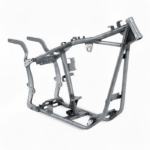
Motorcycle Chassis Welding Powerful 3 Axis Alignment for Handling
Motorcycle chassis welding with 3 axis alignment ensures accurate frame geometry, improved handling, and reliable structural strength for custom motorcycles.
Request a Quote
Enter the quantity you need and add to your quote list for pricing inquiries.
Product Details
Why Aluminum for Motorcycle Frames?
Motorcycle chassis welding is essential for producing lightweight and high-strength motorcycle frames. Aluminum offers clear advantages over steel for this application. It weighs approximately one third as much as steel for the same volume, allowing manufacturers to reduce overall frame weight while improving power-to-weight ratio, suspension response, and rider comfort. Many modern sport bikes and off-road machines use aluminum perimeter frames for precisely these reasons. With advanced motorcycle chassis welding techniques, aluminum frames can achieve excellent structural integrity, durability, and long-term performance under demanding riding conditions.
However, aluminum presents unique challenges. The material loses strength when exposed to high welding temperatures. Without proper technique and post-weld treatment of motorcycle chassis welding, a beautiful weld can hide a softened zone underneath. Our approach addresses this through controlled interpass temperatures and selective heat treatment.
Additionally, aluminum does not show fatigue cracks as clearly as steel before failure. A steel frame may develop visible rust streaks at crack locations. Aluminum cracks often remain invisible until sudden fracture. For this reason, our motorcycle chassis welding process includes dye penetrant inspection on all critical joints.
Types of Aluminum Frames We Work With:
We handle several common frame configurations.
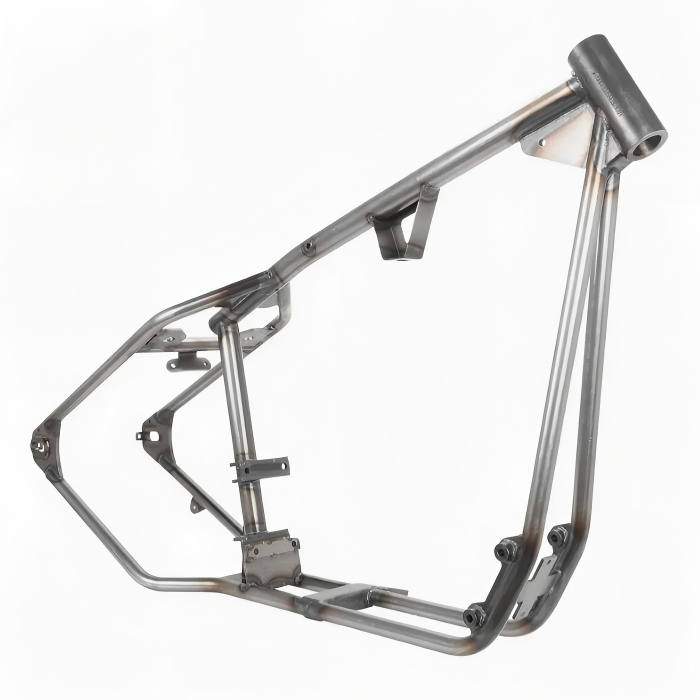
Perimeter Frames – Large diameter extruded tubes that wrap around the engine. Common on sport bikes. Requires precise miter cuts and full penetration butt welds.
Trellis Frames – Multiple small diameter tubes welded into a triangulated structure. Each joint must be clean and fully fused. Used on many European and custom street bikes.
Twin Spar Frames – Two main beams connected by cross members. The welding sequence must control distortion to maintain suspension alignment.
Monocoque Frames – Sheet metal structures that use the frame itself as a stressed member. Thin gauge welding with leak-proof requirements for oil-filled cavities.
Swingarms – Pivoting rear suspension components. Subject to high fatigue loads. Requires careful filler selection and post-weld inspection.
For each type, we adjust our motorcycle chassis welding procedure to match material thickness, joint access, and load requirements.
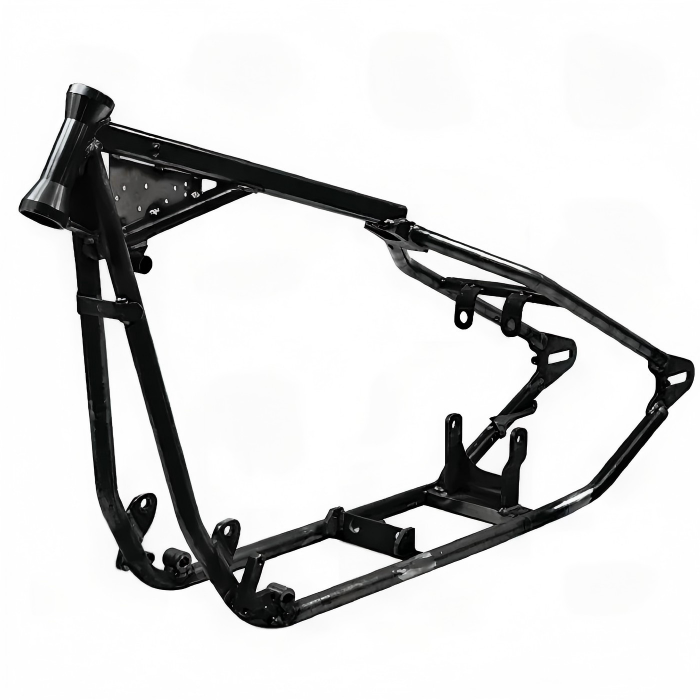
Welding Processes for Frames:
We use AC TIG welding for nearly all motorcycle chassis welding because of the control it offers. TIG allows the welder to modulate amperage with a foot pedal, adding heat when needed and backing off near edges. This is essential for thin-wall tubing where burn-through is a constant risk.
Typical parameters for 1.5mm to 3mm wall tubing include 80 to 140 amps using 3/32 inch 2% ceriated tungsten. We use 4043 filler rod for 6061 frames and 5356 for 5052 or 5083 components. The gas lens on our torches provides excellent argon coverage, which is critical for preventing oxide contamination.
For production runs of identical components, we sometimes use pulsed MIG. This process deposits filler faster than TIG but requires careful parameter setup. Pulsed MIG works well for swingarms and other parts where cosmetic appearance is less critical than deposition rate.
We do not use standard MIG for motorcycle chassis welding because the constant voltage mode creates too much spatter and heat input.
Crack Repair and Structural Restoration:
One of our most requested services is repairing cracked aluminum frames. Cracks typically appear at steering head gussets, swingarm pivots, and shock mount locations. These are high stress areas where vibration concentrates.
Our repair process for motorcycle chassis welding follows these steps.
First, we stop drill the ends of the crack to prevent propagation. A 1/8 inch hole at each crack tip removes the stress concentration. Next, we grind a V-groove along the crack path to ensure full penetration. The area is cleaned with acetone and a stainless steel brush.
We then weld the groove using a slightly oversized filler rod to add material. After welding, we stress relieve the area with localized heating. For major repairs, we recommend post-weld heat treatment of the entire frame section.
Finally, we perform dye penetrant inspection to confirm the crack has been fully eliminated. We also measure frame alignment on a surface table before returning the part.
Distortion Control on Long Tubing:
Motorcycle frames are often composed of long, thin tubes. Welding a single joint on a 36 inch tube can cause the entire assembly to bow. Multiple welds compound the effect. Without control, a frame can pull several millimeters out of alignment.
Our motorcycle chassis welding process uses the following methods to preserve geometry.
Backstep Welding – We weld 1 inch segments in reverse order along each joint. This distributes heat more evenly than continuous welding.
Strongback Fixturing – Our frame jigs clamp the assembly in its correct position during welding. The jig allows some lateral movement to accommodate expansion but prevents permanent distortion.
Weld Sequence Planning – We weld opposing sides of the frame alternately. For example, left side upper rail, then right side upper rail, then left side lower rail. This balances thermal contraction.
Interpass Cooling – We allow the frame to cool to below 150°F between weld passes. A wet rag or compressed air speeds the process.
Using these techniques, we hold frame alignment to within 0.5mm at critical mounting points.
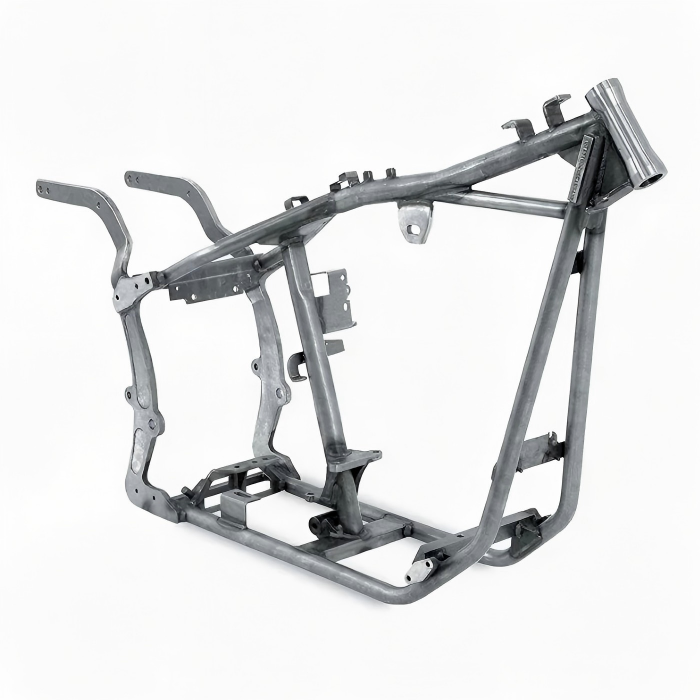
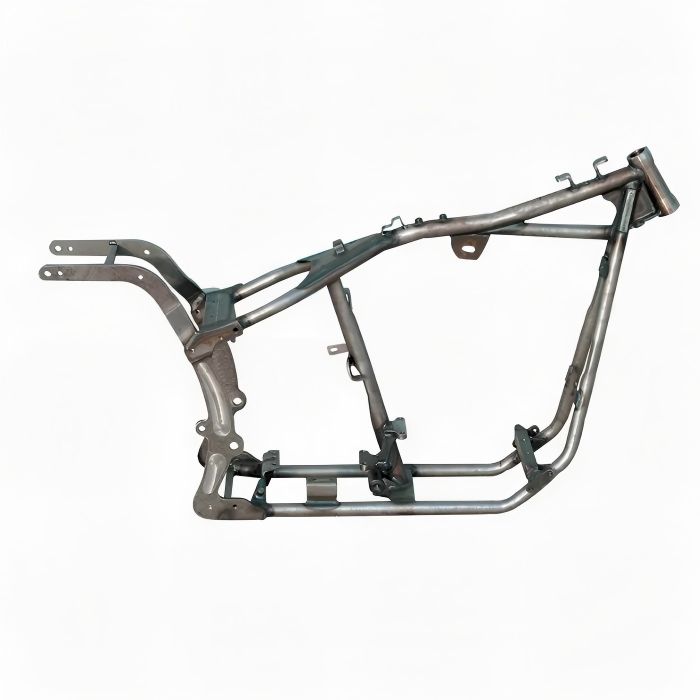
Heat Treatment After Welding:
Aluminum in the T6 temper loses approximately 40 percent of its strength in the heat affected zone after welding. For motorcycle chassis welding, this is unacceptable. The steering head and swingarm pivot must maintain full strength.
We offer post-weld solution heat treatment and artificial aging for 6061 frames. The process involves heating the entire frame to 980°F, quenching in water, then aging at 350°F for 8 hours. This restores the original T6 temper across the entire structure.
For 5000 series alloys like 5052 and 5083, heat treatment does not restore strength. Instead, we use cold working techniques and careful filler selection to maintain performance.
We maintain a large oven that accommodates full frames up to 84 inches long. Smaller components like swingarms and subframes are also welcome.
Quality Inspection Methods:
Motorcycle chassis welding quality is ensured through multiple inspection levels before every frame leaves our shop.
Visual Inspection – Each weld is examined for cracks, porosity, undercut, and incomplete fusion.
Dimensional Inspection – We check critical measurements including steering head angle, swingarm pivot alignment, and shock mount locations. Tolerances are typically plus or minus 0.5mm.
Dye Penetrant Testing – Used on all structural welds for racing and custom frames. Reveals surface cracks invisible to the naked eye.
X-Ray Inspection – For professional racing frames and high value restorations. Radiography shows internal fusion and porosity.
Alignment Fixture – We bolt the finished frame into a dedicated alignment jig to verify straightness before shipping.
For customers who need documentation, we provide a certified inspection report with each motorcycle chassis welding order.
Common Applications:
Our service supports several segments of the motorcycle industry.
Custom Builders – One-off frames for choppers, cafe racers, and street trackers. We work from your drawings or from an existing jig.
Race Teams – Lightweight frames for drag racing, road racing, and flat track. Crack repair and reinforcement of factory frames.
Restoration Shops – Repairing cracked frames on vintage Japanese and European motorcycles. Matching original weld appearance when specified.
Adventure Bike Modifications – Reinforcing subframes for heavy luggage loads. Adding mounting points for auxiliary fuel tanks.
Electric Motorcycle Conversion – Adapting existing frames for battery and motor mounting. Adding structural members as needed.
For each application, we provide design feedback to improve weldability and reduce cost.