
For the tig welding aluminum parts, is your robotic aluminum weld weaker than a manual weld? Discover the hidden causes of porosity, lack of fusion, and heat-affected zone damage and how to fix your robot program.
You have invested thousands in a robotic welding cell. It is fast. It is consistent. It never calls in sick.
But there is a problem.
Your tensile tests keep failing. The robotic weld breaks. Meanwhile, the old welder down the hall—the one who has been welding aluminum for 20 years—produces joints that pass every time.
How is this possible? Isn’t a robot supposed to be more precise?
Here is the uncomfortable truth: For aluminum welding, precision without adaptation can actually create weaker joints.
In this article, we will explain the science behind robotic aluminum weld failure and give you actionable fixes to match—or exceed—manual weld strength.
—
The Core Problem: Aluminum is Not Steel
Most welding engineers grew up programming robots for steel. Steel is forgiving.
Aluminum is not.
Aluminum has three characteristics that punish rigid robotic programming:
| Property Challenge | Impact on Robotic Welding |
| High Thermal Conductivity | Heat dissipates instantly. The weld pool state changes rapidly, requiring the robot to adjust parameters quickly and precisely. |
| Low Melting Point | Melts at 1,220°F (660°C) – a very narrow process window between solid and collapse (burn-through), demanding high robot stability and parameter consistency. |
| Oxide Layer | Melts at 3,700°F (2,037°C) – much hotter than the base metal. The robot must ensure this “barrier”; is effectively removed before or during welding to prevent defects. |
A manual welder feels these changes. A robot executes a script. That difference is where strength dies. Custom Tig Welding Aluminum Parts in Flow Wing!
Custom Tig Welding Aluminum Parts in Flow Wing!

5 Reasons Robotic Aluminum Welds Can Be Weaker in Tig Welding Aluminum
1. Lack of Fusion (The “Cold Lap” Trap)
Manual welder: When a human sees the puddle not wetting out, they pause. They add a slight weave. They let the heat build.
Robot: The robot follows a rigid path at a rigid speed. If the starting temperature of the part is cold (morning shift), the robot does not compensate.
Result: The weld bead sits on top of the base metal instead of fusing into it. This is called cold lap or lack of fusion. Under load, the weld peels right off.
2. Porosity from Gas Entrapment
Manual welder: A skilled welder constantly adjusts torch angle and stick-out to maintain perfect gas coverage. If they hear a crackling sound, they react instantly.
Robot: The robot holds the same torch angle even if the joint geometry changes slightly. Turbulent gas flow becomes trapped in the solidifying puddle.
Result: Microscopic gas pockets (porosity) inside the weld. Porosity acts like perforations in a soda can. Under stress, cracks initiate and propagate through these voids.
3. Heat-Affected Zone (HAZ) Softening
Manual welder: A human can “haul ass” (travel fast) to minimize heat input. They know that slower speeds = bigger HAZ = weaker joint.
Robot: Many robotic programs prioritize stability over speed. They run conservatively slow. This dumps excessive heat into the surrounding base metal.
Result: The heat-affected zone (HAZ) anneals (softens) the aluminum. For heat-treatable alloys like 6061-T6, the strength can drop from 45,000 psi to as low as 24,000 psi—a nearly 50% loss.
4. Inconsistent Root Penetration
Manual welder: A human watches the keyhole (the opening at the front of the puddle). They push filler wire deeper when penetration is shallow.
Robot: Unless equipped with adaptive control, the robot does not “see” the root gap. If the fit-up varies by even 1 mm, the robot deposits the same amount of wire.
Result: Partial penetration on thick sections. The weld looks fine on the surface, but the root is only 50% bonded. This is a guaranteed failure point.
5. Oxide Layer Entrapment
Manual welder: Before striking an arc, a manual welder vigorously wire-brushes the joint. During welding, the “cleaning action” of AC TIG breaks up remaining oxide.
Robot: If the robot program does not include specific AC balance settings for oxide cleaning, or if the part was not pre-cleaned consistently, the robot welds through the oxide.
Result: The high-melting-point oxide (3,700°F) gets trapped inside the weld as a brittle inclusion. This acts as a crack starter.
Custom Tig Welding Aluminum Parts in Flow Wing!
—
Case Study: Manual vs. Robotic – By the Numbers
| Measurement | Manual Welder (Experienced) | Robot (Poorly Programmed) | Robot (Optimized) |
| Ultimate Tensile Strength (UTS) | 38,000 psi | 24,000 psi | 39,000 psi |
| Porosity Rate | <1% | 5-8% | <1.5% |
| HAZ Width | 8 mm | 18 mm | 9 mm |
| Pass/Fail (Cyclic Load Test) | Pass (10,000+ cycles) | Fail (2,000 cycles) | Pass (10,000+ cycles) |
Data based on 6061-T6 aluminum with 4043 filler wire, 3mm thickness.
The takeaway? A robot can match manual strength—but only with the right programming philosophy.
—
How to Fix Your Robot: 5 Upgrades for Stronger Welds
You don’t need to abandon automation. You need to teach your robot to think like a welder.
✅ Fix 1: Add Adaptive Welding (Seam Tracking)
· The problem: The robot cannot see gap variation.
· The fix: Install through-arc seam tracking (TAST). This allows the robot to sense joint position and adjust in real time.
· Result: Consistent root penetration even with poor fit-up.
✅ Fix 2: Use Synergic Pulse Parameters
· The problem: Constant amperage overheats the puddle.
· The fix: Program pulsed TIG or pulsed MIG. High peak current penetrates; low background current cools the HAZ.
· Result: Narrower HAZ, less softening, higher strength.
✅ Fix 3: Increase Travel Speed
· The problem: Slow speeds = high heat input.
· The fix: Run a test matrix. Increase travel speed by 15-20% while maintaining penetration.
· Result: Lower heat input means the aluminum retains more of its original temper (T4/T6 properties).
✅ Fix 4: Optimize AC Balance (For TIG)
· The problem: Too much cleaning action = tungsten erosion. Too little = oxide entrapment.
· The fix: Set AC balance to 70-75% electrode negative (EN) . This gives enough cleaning without overheating the tungsten.
· Result: Oxide-free welds without embedded inclusions.
✅ Fix 5: Pre-Heat and Interpass Temperature Control
· The problem: Cold starts = lack of fusion. Overheating = HAZ softening.
· The fix: Program the robot to wait until interpass temperature returns to 150-200°F before the next pass. Use an infrared sensor.
· Result: Consistent fusion from first pass to last.
Flow Wing can provide you with a unique production solution for TIG welding aluminum parts.
—
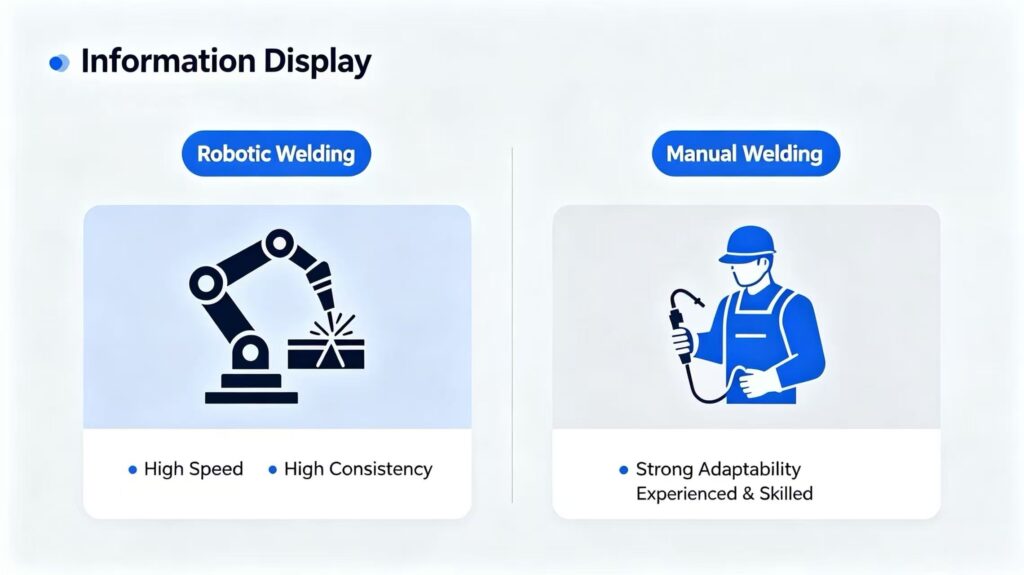
Final Verdict: Manual vs. Robotic – Who Wins?
A skilled manual welder will almost always beat a poorly programmed robot.
But a well-programmed robot with adaptive controls can match—and often exceed—manual weld strength for production runs.
Here is the reality:
| Aspect | Manual Welding (Experienced) | Robotic Welding (Optimized) |
| Strength | Excellent | Excellent (with correct settings) |
| Consistency | Varies (fatigue, distractions) | Extremely consistent |
| Speed | Slow on long runs | Fast |
| Adaptability | Superior (can see and react to problems) | Requires sensors and programming |
| Best for… | Prototypes, repairs, odd geometries | High-volume production |
Have you ever encountered any products that are difficult to produce through TIG welding aluminum parts?
Action Plan for Your Factory for Tig Welding Aluminum Parts
If your robotic tig aluminum welds are failing strength tests:
1. Stop running at constant parameters. Add pulsed welding.
2. Increase travel speed to reduce heat input.
3. Install seam tracking if fit-up is inconsistent.
4. Pre-heat to 150°F before the first weld.
5. Test, record, and iterate. Keep a log of parameters vs. tensile results.
The robot is not the problem. The program is.
Fix the program, and your robot will produce welds that are just as strong—and far more repeatable—than your best human welder.
Flow Wing is your best choice for tig welding aluminum parts manufacturing.
—
Need help optimizing your robotic aluminum welding process? We provide process engineering consulting and certified Tig welding Aluminum Parts services. Contact us!