Choosing between stamping and CNC machining is not simply a matter of deciding which process is cheaper. For engineers and purchasing teams, the right manufacturing process depends on part geometry, material, tolerance, production volume, tooling investment, lead time, and the total cost of production.
Both processes can produce accurate metal components, but they work in fundamentally different ways. Stamping forms sheet metal using dies and controlled press force, while CNC machining removes material from a solid blank to create the required geometry.
Understanding where each process performs best can help you avoid unnecessary tooling costs, excessive material waste, or a production method that is difficult to scale.
Stamping vs. CNC Machining: How Do They Work?
Metal stamping uses a punch, die, and press to cut, bend, form, or emboss sheet metal. Once the tooling is developed, the same operation can be repeated at high speed with consistent results. Progressive dies can also combine several operations in one production sequence.
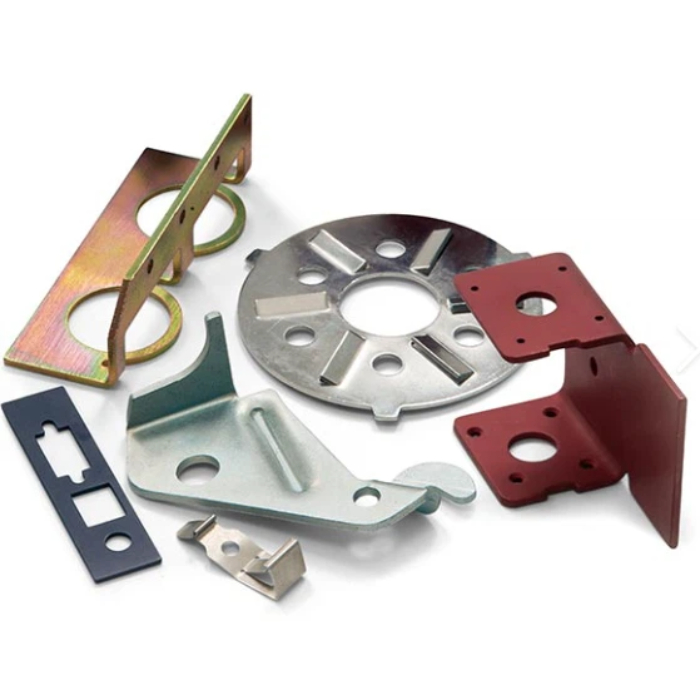
For manufacturers producing brackets, clips, covers, terminals, washers, shields, and other sheet-metal components, stamping can be particularly efficient when the geometry is suitable for forming.
In comparison, CNC machining is a subtractive process. A CNC machine starts with a solid block, bar, or other stock material and removes material using milling, turning, drilling, or other cutting operations. It is well suited to complex 3D geometries, tight tolerances, prototypes, and lower-volume production.
| Factor | Stamping | CNC Machining |
| Basic process | Forming/cutting sheet metal | Removing material |
| Tooling | Die required for many production parts | No dedicated forming die |
| Production volume | Medium to very high | Prototype to medium/high volume |
| Material utilization | Often efficient from coil/sheet | More material becomes chips |
| Complex 3D geometry | More limited | Excellent |
| Unit cost at high volume | Often lower | Usually higher |
| Design changes | Tooling changes can be costly | CAD/program changes are easier |
The important point is that neither process is universally better. The right choice depends on the part and production requirements.
When Does Stamping Make More Sense?
The strongest advantage of stamping appears when production volume is high and the part can be efficiently produced from sheet or coil material.
Once the die is qualified, each additional part can be produced with relatively little incremental setup. This makes stamping attractive for components that may be ordered in tens of thousands or millions of pieces.
Typical stamping applications include:
- Brackets and mounting plates
- Clips and retaining components
- Electrical terminals
- Shields and covers
- Automotive hardware
- Appliance components
- Medical equipment components
- Industrial sheet-metal parts
Material selection also matters. Stainless steel, carbon steel, aluminum, copper, brass, galvanized steel, and other sheet materials can be processed depending on thickness and part geometry.
For companies sourcing custom metal stamping, the tooling decision should therefore be evaluated together with annual demand rather than looking only at the initial die cost. You can see examples of different stamped components in our Metal Stamping product range.

When Is CNC Machining the Better Choice?
CNC machining becomes more attractive when the component requires geometries that are difficult or impractical to produce through stamping.
Typical examples include parts with:
- Deep pockets
- Complex 3D contours
- Internal threads
- Undercuts
- Multiple precision surfaces
- Tight dimensional tolerances
- Low production quantities
CNC also offers flexibility during product development. If an engineer changes a hole position or modifies a pocket, the manufacturing program can often be adjusted without rebuilding an entire stamping die.
This makes CNC particularly useful for prototypes, engineering samples, low-volume production, and complex precision components.
For example, a machined aluminum housing may require several milling and drilling operations but would not necessarily be an appropriate candidate for sheet-metal stamping. On the other hand, a simple stainless steel bracket produced in large quantities could be unnecessarily expensive if every part is machined from solid bar.
The key question is therefore not “Is CNC more precise?” but rather “Does the part actually require CNC machining to achieve its functional requirements?”
Cost, Volume, and Design: The Three Factors Engineers Should Compare
The most common mistake in process selection is comparing only the unit price.
A better evaluation considers the complete manufacturing cost:
Total Production Cost = Tooling + Material + Processing + Secondary Operations + Inspection + Logistics
For stamping, tooling can represent a significant upfront investment. However, that cost is distributed across a large production quantity.
For CNC machining, tooling costs may be lower at the beginning, but machining time and material removal can make the recurring unit cost higher as production volume increases.
A simplified production-volume model:
| Production Situation | More Suitable Starting Point |
| Prototype / very low volume | CNC machining |
| Small batch with frequent design changes | CNC machining |
| Medium volume | Compare both |
| High-volume repetitive part | Stamping |
| Very high annual demand | Progressive stamping often worth evaluating |
| Complex 3D geometry | CNC machining |
Part geometry can change the calculation completely. A simple flat bracket with several holes may be an excellent stamping candidate, while a thick block with deep pockets may be much better suited to CNC machining.
For procurement teams, requesting both manufacturing approaches during RFQ can sometimes reveal significant differences in long-term production cost.
Case Study: Replacing CNC Machining with 316L Stamping
The Challenge:
One of our medical-device projects involved a small 316L stainless steel bracket used in a reusable surgical instrument sterilizer rack. The customer required around 250,000 pieces per year, but the original component was CNC machined from solid 316L bar.
The machining process delivered the required part, but the production volume made it costly and time-consuming. The unit cost was $4.20, with an 8-week lead time for 5,000 pieces, while about 65% of the material became chips and scrap.
Our Stamping Solution:
We reviewed the part geometry and production requirements and redesigned the component for progressive stamping. The new design uses 1.2 mm 316L stainless steel coil, with multiple forming and piercing operations integrated into an 8-station progressive die.
We also optimized the internal corners and hole tolerances to improve forming reliability and alignment accuracy. After stamping, the parts were deburred and passivated to meet the requirements of the medical application.
The Results:
The change from CNC machining to stamping produced measurable improvements:
- Unit cost: $4.20 → $1.52
- Material utilization: 35% → 82%
- Production: 5,000 pcs / 8 weeks → 25,000 pcs / 2 weeks
- Hole position: achieved ±0.03 mm
- Autoclave durability: passed 800 cycles
This project shows that when production volume is high and the part can be optimized for forming, stamping can provide significant advantages over machining.
See the full 316L stamping brackets case study for more project details.
How to Choose the Right Process for Your Part?
There is no single manufacturing process that fits every metal part. The right choice depends mainly on production volume, part geometry, material, tolerance, and total production cost.
As a general rule, CNC machining is often suitable for prototypes, low-volume production, and complex geometries, while stamping becomes increasingly attractive for repetitive parts and higher production volumes.
For some components, a combination of stamping and CNC machining can also provide a practical balance between production efficiency and precision.
If you have a drawing and are unsure which process is more suitable, contact our team with your material, quantity, dimensions, and tolerance requirements. We can evaluate the part and recommend a suitable manufacturing approach.